5-Amino-1MQ: Chemical Identity and NNMT Research
By Vanta Labs Research teamPublished 11 min read
5-Amino-1MQ (5-amino-1-methylquinolinium) is a small-molecule NNMT inhibitor, not a peptide. This guide covers its verified chemical identity, what the published research actually examines, and how to evaluate claims about it.
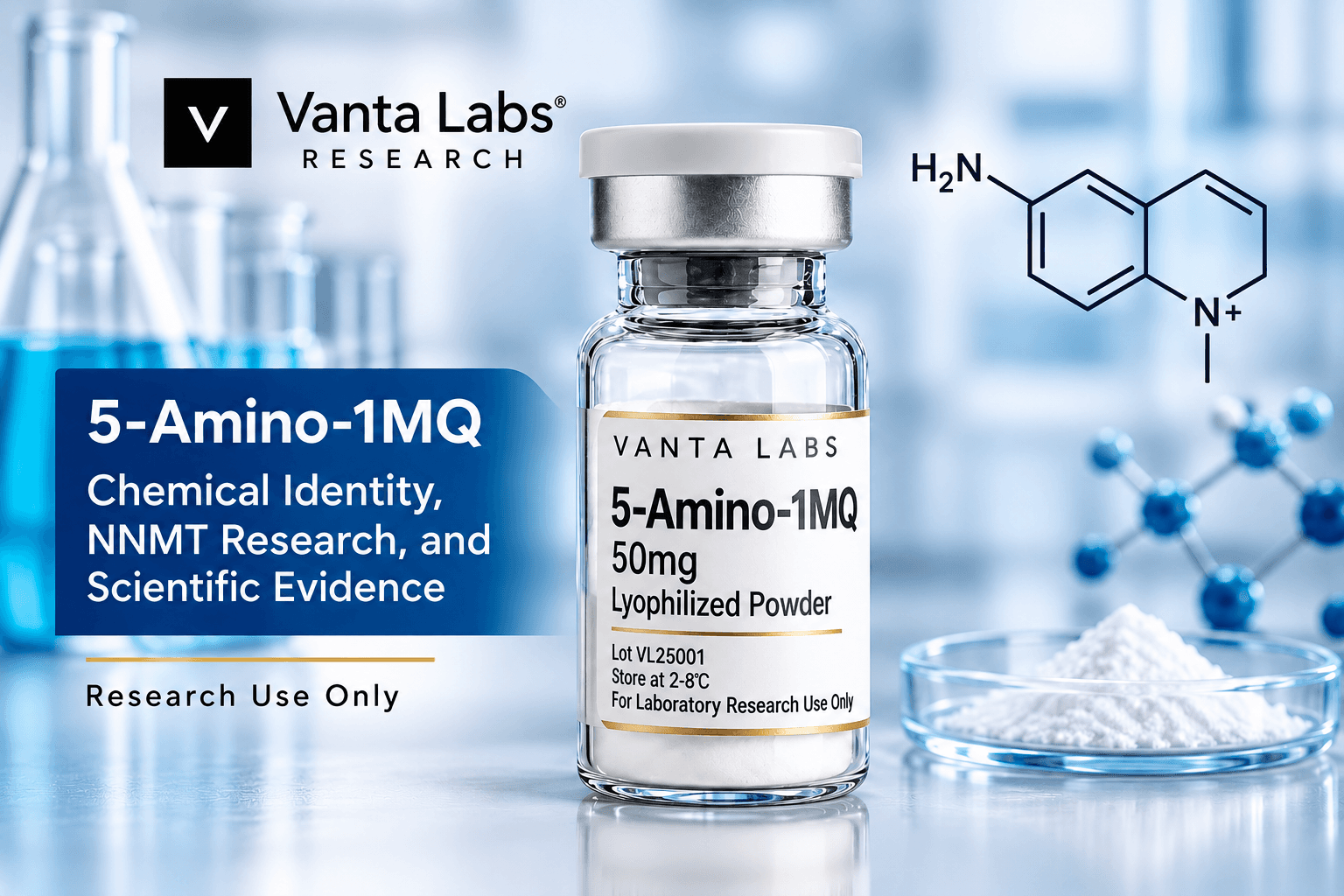
What Is 5-Amino-1MQ?
5-Amino-1MQ is the common shorthand for 5-amino-1-methylquinolinium, a small organic molecule identified in the scientific literature as CAS number 685079-15-6 and listed in PubChem under CID 950107. Structurally, it belongs to the methylquinolinium family: a quinolinium cation bearing a primary amine substitution, with the molecular formula C10H11N2+ and a molecular weight of 159.21 g/mol for the reference cation.
The compound entered the research literature through work on nicotinamide N-methyltransferase (NNMT) inhibition, where methylquinolinium scaffolds were investigated for their ability to cross cell membranes while selectively blocking that single enzyme target. It is sold and discussed almost exclusively in the research-chemical and research-peptide marketplace, which is where most readers first encounter the name.
It is worth stating plainly at the outset what this article is not: it is not a guide to using, dosing, or administering 5-Amino-1MQ, and it does not describe or imply any health, metabolic, or performance benefit. It is a chemical and research-literature reference, written for laboratory research use only.
Is 5-Amino-1MQ Actually a Peptide?
No. A peptide is a chain of amino acids linked by peptide bonds, ranging from a few residues to a few dozen. 5-Amino-1MQ has no amino-acid sequence at all. It is a single small organic molecule, a methylquinolinium salt, built around a quinoline ring rather than an amino-acid backbone.
The search term "5-amino-1mq peptide" is common anyway, largely because research-chemical retailers often group small molecules like this one in the same catalog category as actual peptides (growth-factor analogs, NAD+ precursors, and similar research compounds), simply because they share a customer base and a research-use positioning. That catalog convenience does not make the underlying chemistry a peptide. When evaluating any source describing 5-Amino-1MQ, a supplier calling it a "peptide" is using the word loosely, as a category label, not as an accurate chemical classification, and that distinction matters for anyone trying to find the correct primary literature.
Understanding 5-Amino-1MQ's Chemical Identity
A single product name is not a reliable way to identify a chemical. Several independent reference points need to line up before a sample can be considered correctly identified:
- Chemical name and synonym: 5-Amino-1MQ, formally 5-amino-1-methylquinolinium.
- CAS Number: 685079-15-6, a registry number specific to this cation.
- PubChem CID: 950107, which links to the compound's full computed and experimental property record.
- Molecular formula and weight: C10H11N2+, 159.21 g/mol, describing the cation itself.
- Reference structure: the quinolinium ring system with its amine substitution, as deposited in PubChem.
These fields are meant to cross-check each other. A vial labeled "5-Amino-1MQ" that does not correspond to this CAS number, this PubChem CID, and this formula on an accompanying analytical report has not actually been identified as this compound, regardless of what the label says. Readers comparing a product listing against the compound's reference identity should expect to see this same CAS number and PubChem CID reproduced consistently, not just the product name.
Understanding NNMT and Its Scientific Classification
Nicotinamide N-methyltransferase, abbreviated NNMT, is a cytosolic enzyme that transfers a methyl group from S-adenosyl-methionine (SAM) onto nicotinamide, producing 1-methylnicotinamide (1-MNA) as the reaction product. It is expressed predominantly in the liver, with lower levels detected in other tissues, and it sits at the intersection of two metabolic pathways: the methionine cycle (through its SAM-consuming reaction) and the NAD+ salvage pathway (through its nicotinamide-consuming reaction).
In biochemical terms, an "NNMT inhibitor" is a molecule that reduces the enzyme's catalytic activity, measured in laboratory assays as a drop in 1-MNA formation or a change in substrate turnover. 5-Amino-1MQ is described in the literature as a substrate-competitive, selective, and membrane-permeable NNMT inhibitor, reported to act at low micromolar potency in enzyme and cell-based assays while showing selectivity against other, structurally related SAM-dependent methyltransferases. This is a description of enzyme pharmacology measured in a laboratory setting. It is not, by itself, a description of any effect in a living person, and this article does not extend it into one.
What Does Published 5-Amino-1MQ Research Actually Examine?
The foundational characterization of 5-Amino-1MQ as an NNMT inhibitor comes from Neelakantan et al., published in Biochemical Pharmacology in 2018 (PMID 29155147), which reported on methylquinolinium-scaffold NNMT inhibitors evaluated for membrane permeability, enzyme selectivity, and effects in cultured adipocytes and in diet-induced obese mice. A separate, later study by Dimet-Wiley et al., published in Scientific Reports in 2022, examined NNMT inhibition in diet-induced obese mice from a different angle, looking at how the intervention related to shifts in the gut microbiome rather than at the enzyme pharmacology itself.
Both studies sit squarely in the preclinical research category: enzyme assays, cultured cell models, and mouse models of diet-induced obesity. Neither paper, nor any other peer-reviewed source identified for this article, reports a human clinical trial of 5-Amino-1MQ. Readers should also note that research on NNMT as a biological target is broader than research on this one compound; many of the enzyme-biology papers in the wider literature discuss NNMT inhibition generally, using other chemical scaffolds, and should not be read as additional evidence specifically about 5-Amino-1MQ.
What Are the Limitations of Preclinical Research?
Preclinical research moves through several distinct models, and results from one model do not automatically carry over to the next:
- In-vitro experiments test a compound directly against a purified enzyme or a biochemical assay, outside of any living cell.
- Cell-culture research adds a layer of biological complexity, testing effects inside living cells grown in a dish, but still outside a whole organism.
- Animal experiments, such as the diet-induced obesity mouse studies cited above, introduce a full physiological system, including organ interactions, metabolism, and whole-body effects, but in a non-human species.
- Human clinical investigations are the only model that can establish how a compound behaves in people, and none have been published for 5-Amino-1MQ.
Each step up this ladder changes variables that the earlier step could not account for: absorption, distribution, metabolism, excretion, species-specific enzyme differences, and dose-response relationships that do not necessarily scale linearly from mice to humans. A result confirmed only in cultured cells or in mice is evidence about cultured cells or mice; it is not evidence about any effect in a person.
What Is Known About Human Research and Clinical Documentation?
A review of ClinicalTrials.gov and PubMed conducted in November 2026 did not identify any registered or completed human clinical trial of 5-Amino-1MQ or 5-amino-1-methylquinolinium. A search of FDA records likewise did not identify any FDA-approved use of the compound, for any indication. This matches the consistent position taken across independent research-literature summaries reviewing the compound as of 2026: the published evidence base is preclinical only.
This is a factual statement about the state of the documented record at the time of writing, not a forecast about future research. Readers who want the current status should check ClinicalTrials.gov and PubMed directly, since clinical-trial registries are updated continuously and any claim about human research should be verified against the primary registry rather than taken from a secondary source, including this one.
Why Do Molecular Weight and Salt Forms Matter?
The molecular weight and formula given above (159.21 g/mol, C10H11N2+) describe the 5-amino-1-methylquinolinium cation itself. A cation on its own is not a stable, isolable solid; it is typically paired with a counter-ion to form a salt, such as an iodide salt, which is the form referenced in some published characterizations of this compound.
Different counter-ions change the total molecular weight of the salt, even though the active cation and its biochemical identity stay the same. This means a molecular-weight figure quoted for the bare cation cannot be assumed to match the total weight of a specific salt form supplied in a vial, and the reverse is also true: a vial's stated weight does not by itself confirm which counter-ion, if any, is present. Establishing which salt form a particular research sample actually is requires sample-specific analytical documentation, not an assumption drawn from the reference cation's published properties.
How Should a Research Compound's COA Be Evaluated?
A certificate of analysis (COA) is a laboratory document reporting what was actually measured in a specific sample, as opposed to what is generally known about a compound's reference identity. A COA that is doing its job will typically identify several things clearly:
- Compound identification, confirming the sample matches the intended chemical identity (ideally cross-referenced against a CAS number or PubChem CID).
- Batch or lot identification, tying the report to one specific production run rather than the product line in general.
- Testing laboratory, named and, ideally, independently verifiable.
- Analytical method, such as HPLC or LC-MS, since different methods have different strengths and blind spots.
- Testing date, establishing when the sample was analyzed.
- Report traceability, meaning the report can be matched back to the exact vial or batch it describes.
A COA can establish identity and purity for the specific batch it was run on, at the time it was run. It cannot establish that every future batch sold under the same product name will match it, and it cannot substitute for independent verification by a reader who wants certainty rather than a supplier's representation. A general compound reference, such as the PubChem record cited above, is not a substitute for a batch-specific COA, and a batch-specific COA is not evidence about any batch other than the one it names.
Understanding 5-Amino-1MQ's Research Use Only Classification
"Research Use Only," commonly abbreviated RUO, is a labeling convention used for laboratory materials that have not gone through the regulatory approval process required for a medicine, a veterinary drug, or a dietary supplement. An RUO label signals that a compound is intended for laboratory research settings, such as in vitro assays or preclinical studies, and is not intended for human or veterinary use.
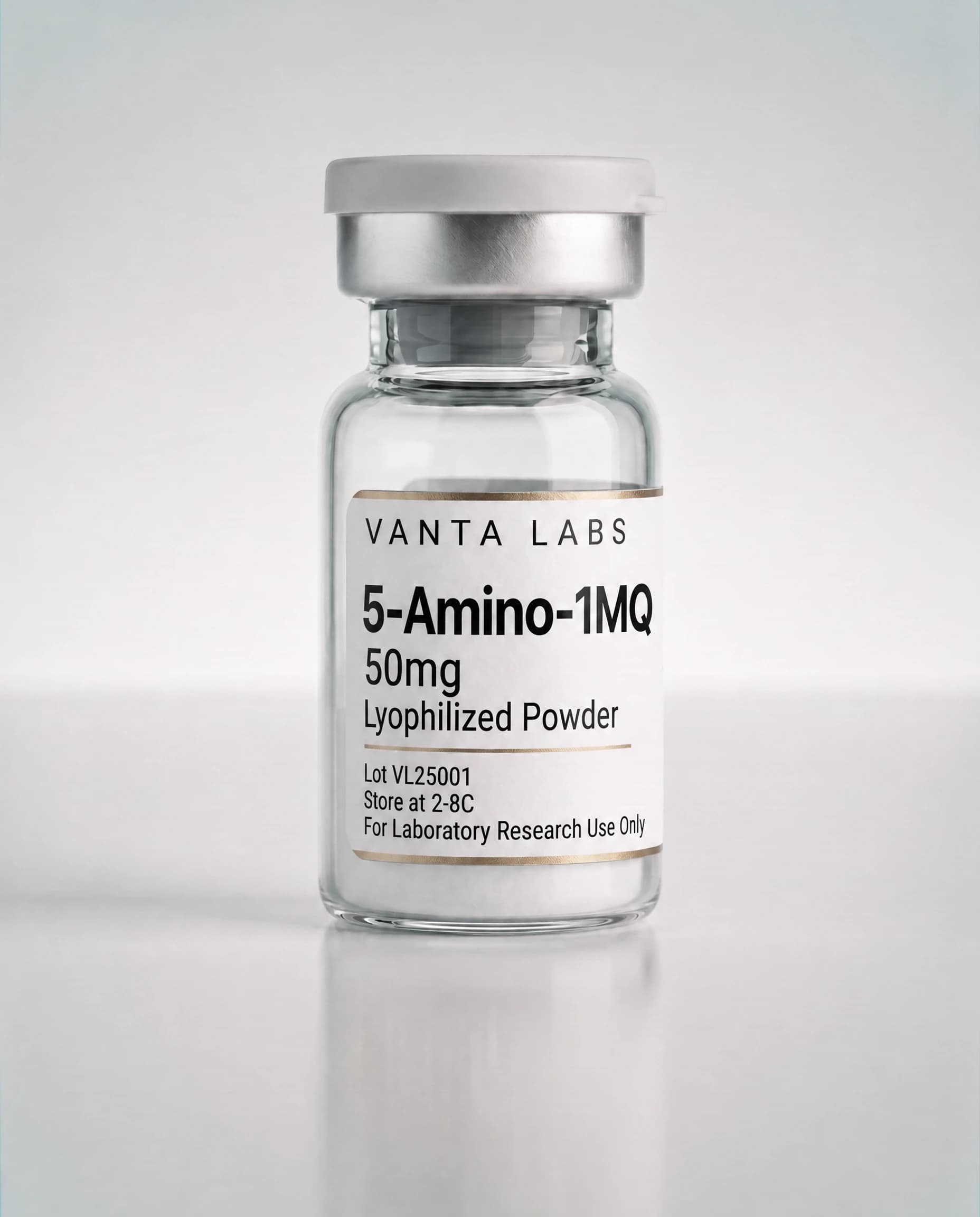
Vanta Labs lists its 5-Amino-1MQ product under this Research Use Only positioning. This classification is a statement about intended use, not a judgment this article is positioned to make about legal status in every jurisdiction, and it does not override anything stated elsewhere in this article about the compound's actual research evidence.
How to Evaluate Scientific Information About 5-Amino-1MQ
Given how much commercial content surrounds research compounds like this one, it helps to have a working framework for sorting sources by reliability:
- Peer-reviewed publications, such as the Neelakantan 2018 and Dimet-Wiley 2022 papers cited above, have gone through independent expert review before publication, though that review does not make their conclusions automatically generalizable beyond the model they tested.
- Primary research data, meaning the original study itself rather than a description of it, is the most reliable starting point for understanding what was actually measured.
- Chemical database records, such as PubChem, are useful for identity and structural data but say nothing about biological effects.
- Supplier descriptions, including product pages and marketing copy, can be a useful starting point for sourcing information but should be checked against a primary source before being treated as fact, since suppliers are not disinterested parties.
- Unsupported online statements, common on forums, aggregator blogs, and un-sourced "research guides," are the least reliable tier and should generally be treated as a lead to verify elsewhere, not as a citation in themselves.
A reader applying this framework to any claim about 5-Amino-1MQ should ask, specifically, which tier the claim is coming from, and whether it has been checked against the tier above it.
Common Questions About 5-Amino-1MQ
The sections above cover the compound's chemical identity, its classification as an NNMT inhibitor, and the state of the published research. The FAQ section answers the specific, recurring questions that readers searching for this compound tend to ask, without repeating the longer explanations already given.
Research Use Only. This article is provided for educational and research-reference purposes only. 5-Amino-1MQ, as discussed here and as listed by Vanta Labs, is not intended for human or veterinary use, and nothing in this article should be read as medical, dosing, or safety guidance.
Frequently asked questions
What is 5-Amino-1MQ?
5-Amino-1MQ is the common name for 5-amino-1-methylquinolinium, a small organic molecule (CAS 685079-15-6, PubChem CID 950107) studied in the research literature as an inhibitor of nicotinamide N-methyltransferase (NNMT). It is a chemical reference compound used in laboratory research, not an approved medicine or supplement.
Is 5-Amino-1MQ a peptide?
No. 5-Amino-1MQ has no amino-acid sequence and is not built from peptide bonds. It is a quinolinium-based small molecule. It is often listed alongside research peptides commercially because they share a research-chemical marketplace, not because they share a chemical class.
What is the full chemical name of 5-Amino-1MQ?
Its full chemical name is 5-amino-1-methylquinolinium. This is the name used in its PubChem record (CID 950107) and in the peer-reviewed literature describing it as an NNMT inhibitor.
What is the CAS number of 5-Amino-1MQ?
The CAS Registry Number for 5-Amino-1MQ is 685079-15-6. This number should match across any reliable source describing this specific compound.
What is the molecular formula of 5-Amino-1MQ?
The molecular formula of the 5-amino-1-methylquinolinium cation is C10H11N2+, with a molecular weight of 159.21 g/mol, as recorded in its PubChem entry.
What does NNMT stand for?
NNMT stands for nicotinamide N-methyltransferase, a cytosolic enzyme that methylates nicotinamide using S-adenosyl-methionine as the methyl donor, sitting at a junction between the methionine cycle and the NAD+ salvage pathway.
What is the difference between a chemical reference identity and a batch-specific COA?
A chemical reference identity, such as a PubChem record, describes what the compound is in general: its structure, formula, and weight. A batch-specific certificate of analysis describes what was actually measured in one particular production batch. The first tells you what to look for; the second tells you whether a specific sample matches it.
Does this article provide 5-Amino-1MQ dosage instructions?
No. This article does not provide dosage, administration, reconstitution, or usage instructions of any kind. 5-Amino-1MQ is positioned for laboratory research use only, and dosing guidance falls outside the scope of an educational chemical and research-literature reference.
What is established about human research on 5-Amino-1MQ?
A review of ClinicalTrials.gov, PubMed, and FDA records conducted in November 2026 did not identify any completed or registered human clinical trial, or any FDA-approved use, for 5-Amino-1MQ. The published evidence base consists of enzyme assays, cell-culture studies, and diet-induced obesity mouse models.
What does Research Use Only mean?
Research Use Only (RUO) indicates a material is intended for laboratory research settings, such as in vitro or preclinical studies, and has not gone through the approval process required for use as a human medicine, veterinary drug, or dietary supplement. It is not intended for human or veterinary use.
How can a reader identify the correct chemical reference for this compound?
Check that a source's stated CAS number (685079-15-6), PubChem CID (950107), molecular formula (C10H11N2+), and molecular weight (159.21 g/mol) all match. A product name alone, without these matching identifiers, is not sufficient confirmation.
Is 5-Amino-1MQ's salt form the same as its reference cation?
Not necessarily. The reference molecular weight and formula describe the bare cation. A physical sample is typically supplied as a salt paired with a counter-ion, which changes the total molecular weight. Confirming which salt form a specific sample is requires sample-specific analytical documentation, not an assumption drawn from the cation's reference data.
Related products
Sources
- Neelakantan H, Vance V, Wetzel MD, Wang HL, McHardy SF, Finnerty CC, Hommel JD, Watowich SJ. Selective and membrane-permeable small molecule inhibitors of nicotinamide N-methyltransferase reverse high fat diet-induced obesity in mice. Biochemical Pharmacology. 2018;147:141-152.
- Dimet-Wiley A, et al. Reduced calorie diet combined with NNMT inhibition establishes a distinct microbiome in DIO mice. Scientific Reports. 2022.
- PubChem, National Center for Biotechnology Information. 5-Amino-1-methylquinolinium, CID 950107.
- ClinicalTrials.gov, U.S. National Library of Medicine. Search conducted November 2026.
- FDA Drugs@FDA database, U.S. Food and Drug Administration.
- Vanta Labs, 5-Amino-1MQ product page.