Epithalon Research: Telomeres, Identity and Evidence Limits
By Vanta Labs Research teamPublished 16 min read
Epithalon research covers its AEDG molecular identity, telomere and telomerase studies, human evidence limitations, the free base vs. acetate distinction, FDA regulatory status, and batch-specific Certificate of Analysis documentation. For laboratory research use only.
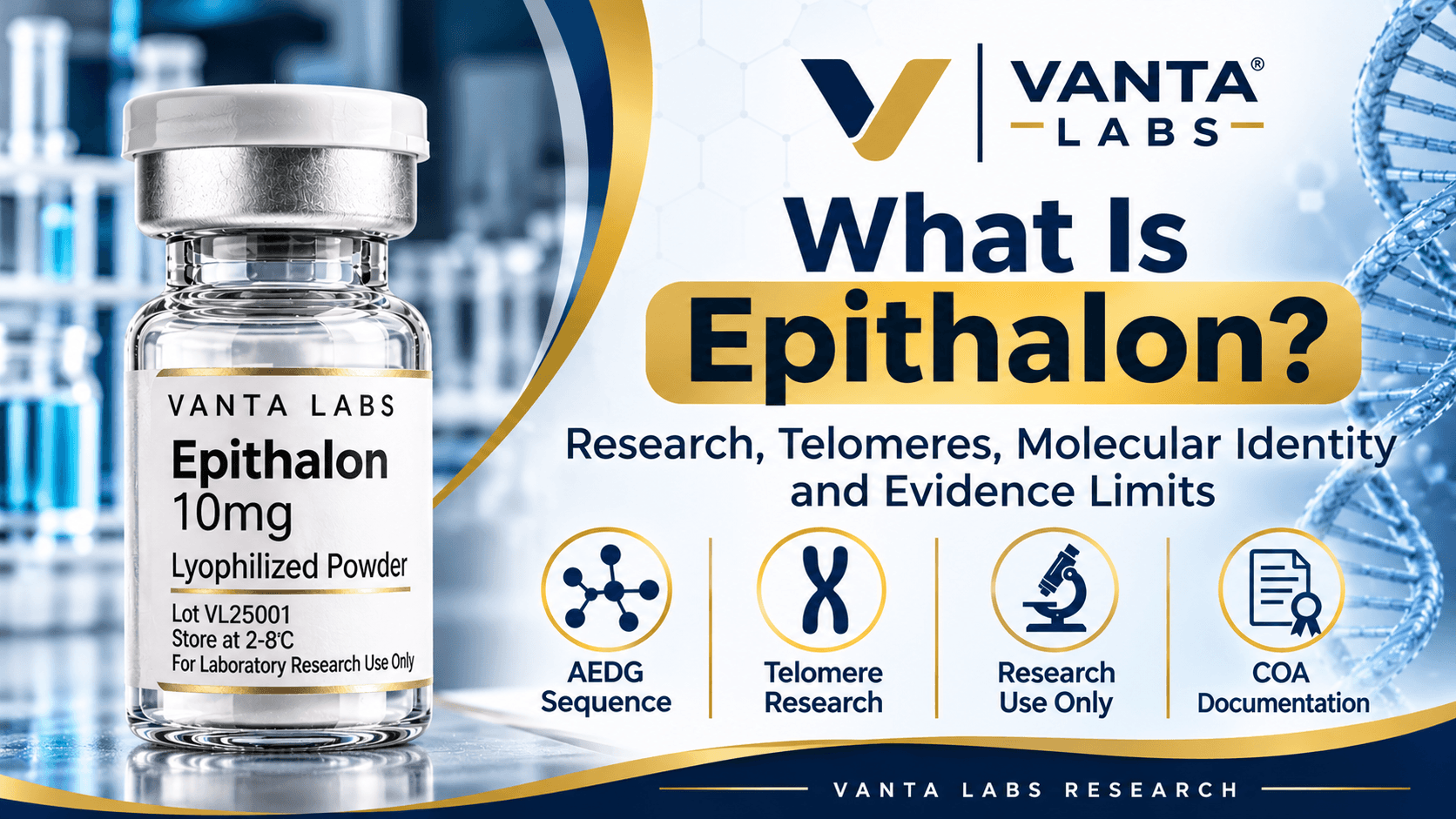
# What Is Epithalon? Research, Telomeres, Molecular Identity and Evidence Limits
Epithalon peptide research centers on a synthetic tetrapeptide studied for its proposed interactions with telomerase and cellular aging pathways in laboratory and small human biomarker studies. Epithalon, also spelled Epitalon and sometimes written Epithalone, carries the amino acid sequence Ala-Glu-Asp-Gly, abbreviated AEDG. It is distinct from Epithalamin, the pineal-derived polypeptide extract it was originally modeled on. This guide is for laboratory research purposes only. It is not intended for human or veterinary use, and it contains no dosage, administration, or personal-use guidance.
What Is Epithalon?
Epithalon is classified as a linear synthetic tetrapeptide built from four amino acids: alanine, glutamic acid, aspartic acid, and glycine, in that sequence (AEDG). Researchers at the Saint Petersburg Institute of Bioregulation and Gerontology originally derived the AEDG sequence from Epithalamin, a polypeptide complex extracted from bovine pineal tissue, and went on to synthesize it as a standalone compound for laboratory study.
Epithalon vs. Epitalon: Are They the Same?
Epithalon and Epitalon are alternate spellings used interchangeably across the scientific and commercial literature for the same AEDG tetrapeptide in its free-base form. Epithalone is a third spelling that appears in some chemical databases. When evaluating a given study, researchers should confirm the exact chemical material tested (free base versus acetate, synthetic versus pineal extract) rather than assuming every mention of these spellings refers to an identical sample.
Epithalon vs. Epithalamin: Understanding the Difference
| Factor | Epithalon (synthetic) | Epithalamin (extract) |
|---|---|---|
| Nature | Single synthetic tetrapeptide, AEDG | Polypeptide complex extracted from bovine pineal tissue |
| Composition | One defined sequence | Mixture of multiple peptide fractions |
| Molecular identity | CAS 307297-39-8, PubChem CID 219042 | Not a single defined compound |
| Research relationship | Developed based on Epithalamin's amino acid composition | Original source material studied decades earlier |
Because Epithalamin is a mixed extract rather than a single molecule, findings from older Epithalamin studies, including an older cohort study in elderly adults, cannot be assumed to transfer to synthetic Epithalon, and the two compounds should be cited as separate research subjects.
Epithalon Molecular Identity and the AEDG Sequence
| Specification | Value |
|---|---|
| Sequence | AEDG (Ala-Glu-Asp-Gly) |
| CAS number | 307297-39-8 (free-base reference) |
| PubChem CID | 219042 |
| Molecular formula | C14H22N4O9 |
| Molecular weight | 390.35 g/mol |
| Classification | Linear synthetic tetrapeptide |
These identifiers correspond to the free-base form of the compound. Researchers comparing sources should confirm which chemical form a given listing describes before treating identifiers as interchangeable.
Epithalon Free Base vs. Epithalon Acetate
Free base and acetate are distinct chemical forms of the same peptide backbone, carrying different CAS numbers and molecular weights because the acetate form includes bound acetate counter-ions.
| Specification | Free base | Acetate |
|---|---|---|
| CAS number | 307297-39-8 | 307297-40-1 |
| Molecular formula | C14H22N4O9 | C14H22N4O9 times C2H4O2 |
| Molecular weight | 390.35 g/mol | 450.40 g/mol |
Vanta Labs lists the free-base form (see the molecular identity table above). The FDA's own 2026 review materials evaluated epitalon free base and epitalon acetate as two separate bulk drug substances, each with its own identifiers, and noted that a certificate-of-analysis-reported formula for the acetate form did not match the summary-table formula in that same briefing material, underscoring that acetate specifications are not settled or interchangeable with the free-base form. Never apply acetate specifications to this listed free-base product.
Epithalon and Telomere Research
What are telomeres? Telomeres are repetitive nucleotide sequences that cap the ends of chromosomes, protecting coding DNA during cell division. Telomere length shortens progressively with each round of cell division in most somatic cells.
What is telomerase? Telomerase is an enzyme complex that can add repeat sequences back onto telomeres, counteracting shortening. Its catalytic subunit is largely inactive in most adult somatic cells, which is one reason telomeres shorten with age in those cell types.
How is Epithalon investigated in telomere research? A foundational 2003 study added synthetic Epithalon to telomerase-negative human fetal fibroblast cultures and reported induced expression of the telomerase catalytic subunit, measurable telomerase enzymatic activity, and telomere elongation in that cell model (Khavinson et al., 2003). A 2025 study from Brunel University London extended this line of research to additional human cell lines, reporting telomere length increases associated with telomerase upregulation in normal cells and with alternative lengthening of telomeres (ALT) activity in cancer cell lines (Al-dulaimi et al., 2025). That paper's original Figures 1, 2 and 3 contained incorrect images; a correction published November 15, 2025 replaced those figures. The correction addressed the figures only; it did not retract the paper or invalidate its reported findings, and both documents should be read together (Correction, 2025).
How should cellular research be interpreted? The studies above are in-vitro cell-culture work. In-vitro findings describe what happens to cells in a laboratory dish under specific, controlled conditions. They do not, on their own, establish what occurs in an intact animal or in a human body.
Human Research on Epithalon: What Exists and What It Shows
Human-related evidence on synthetic Epithalon is substantially narrower than the in-vitro literature and falls into several distinct categories, summarized in a 2026 narrative review (Jain et al., 2026):
- Human biomarker studies. Small studies have measured circadian or melatonin-related biomarkers after Epitalon exposure in adults, including an open study reporting increased nighttime melatonin output and a randomized exposure study in night-shift workers reporting increased urinary melatonin metabolite levels; sleep outcomes in that study were not independently validated and safety was not systematically reported.
- Older controlled clinical report. A retinitis pigmentosa report described parabulbar Epitalon administration in a patient group compared with a group receiving conventional therapy, with a high rate of reported clinical improvement; the review notes that randomization and blinding were not clearly described and the comparison group was not a matched placebo, limiting how the result can be interpreted.
- Human exposure without an adequately powered trial. Across the human studies identified, the 2026 review states that no adequately powered randomized controlled trial has established therapeutic efficacy for Epithalon in any regenerative, musculoskeletal, pain, or longevity-related use.
- In-vitro cellular research. As described above, this is where the majority of Epithalon's mechanistic evidence currently sits.
- Established clinical evidence. None of the human studies reviewed rises to the level of established clinical evidence; human pharmacokinetic, dose-ranging, and dedicated prospective safety studies for synthetic Epithalon were not identified.
It would be inaccurate to state that no human research on Epithalon exists. It is accurate to state that the existing human research is small in scale, methodologically limited, and has not produced an adequately powered randomized trial demonstrating efficacy.
Epithalon Mechanism of Action: Proposed Research Pathways
Published laboratory work has proposed several research pathways associated with the AEDG peptide, each studied in specific models and still requiring further characterization:
- Telomerase-associated research, including catalytic subunit expression in fibroblast cultures (Khavinson et al., 2003).
- Telomere-maintenance pathways, including telomerase upregulation and ALT activity reported in separate human cell lines (Al-dulaimi et al., 2025).
- Gene-expression and histone-binding research, including a proposed epigenetic mechanism behind increased neurogenic differentiation markers in human gingival mesenchymal stem cells (Khavinson et al., 2020).
- Circadian and melatonin-related biomarker research in small human studies, discussed above (Jain et al., 2026).
These pathways are described in the literature as proposed, investigated, or reported in specific models rather than as independently established mechanisms in humans.
What Does Published Epithalon Research Actually Examine?
In-vitro studies. Khavinson, Bondarev, and Butyugov (2003) examined telomerase-negative human fetal fibroblasts, reporting telomerase catalytic subunit expression and telomere elongation. Al-dulaimi, Thomas, Matta, and Roberts (2025, Biogerontology) examined multiple human cell lines, reporting telomere length changes through two distinct pathways depending on cell type, with a November 2025 figure correction. Khavinson and colleagues (2020, Molecules) examined human gingival mesenchymal stem cells, reporting changes in several neurogenic differentiation markers and proposing a histone-binding epigenetic mechanism.
Human studies. As detailed above, human-related research is limited to small biomarker studies and one methodologically limited controlled report; no adequately powered randomized trial has been identified (Jain et al., 2026).
Secondary reviews. Narrative reviews, including Araj and colleagues (2025, International Journal of Molecular Sciences) and Jain and colleagues (2026, International Journal of Molecular Sciences), summarize decades of laboratory and limited human work. These reviews are secondary sources; they synthesize existing primary studies rather than generating new primary evidence, and should not be cited as proof of outcomes beyond what the underlying primary studies report.
Evaluating Epithalon Human Research and Evidence Limitations
The available literature touching synthetic Epithalon in humans is small, concentrated among a limited number of research groups, and has not, according to the 2026 narrative review cited above, produced an adequately powered randomized controlled trial. Human pharmacokinetic, dose-ranging, and dedicated prospective safety data remain unavailable for this compound. These are evidence-quality limitations researchers should weigh before drawing conclusions, separate from the question of how the compound is currently regulated.
Is Epithalon FDA-Approved? Understanding Its Regulatory Status
Epithalon is not an FDA-approved drug. Having a CAS registry number, a PubChem record, or an FDA Global Substance Registration System (GSRS) identifier does not equate to drug approval; these are chemical-identification and registry systems, not approval determinations.
A separate process concerns the FDA's 503A Bulk Drug Substances List, which governs what compounding pharmacies may legally prepare. In a briefing document dated May 12, 2026, prepared ahead of the Pharmacy Compounding Advisory Committee (PCAC) meeting of July 23 to 24, 2026, FDA staff recommended against adding either epitalon free base or epitalon acetate to the 503A Bulks List. FDA's stated reasons included that both forms are not well characterized (inconsistent naming and missing impurity, aggregate, and microbial-quality testing for an injectable product), unresolved immunogenicity concerns, unclear historical compounding use, no identified studies supporting effectiveness for the proposed use, and nonclinical safety data that FDA staff considered too limited, including a theoretical carcinogenicity concern tied to telomerase activation.
At its July 2026 meeting, the PCAC itself voted in favor of recommending several of the nominated peptides, including epitalon, for inclusion on the list, a position that differed from FDA staff's own written recommendation. A committee vote of this kind is non-binding advice to the agency. It is not an FDA drug approval, and it does not by itself add a substance to the 503A Bulks List; a final listing determination remains a separate agency action, and the current, correct position as of this writing is that FDA staff recommended against inclusion while the advisory committee recommended in favor, with no final agency decision on the list and no FDA drug approval of either form.
Understanding the Vanta Labs Epithalon Product Specifications
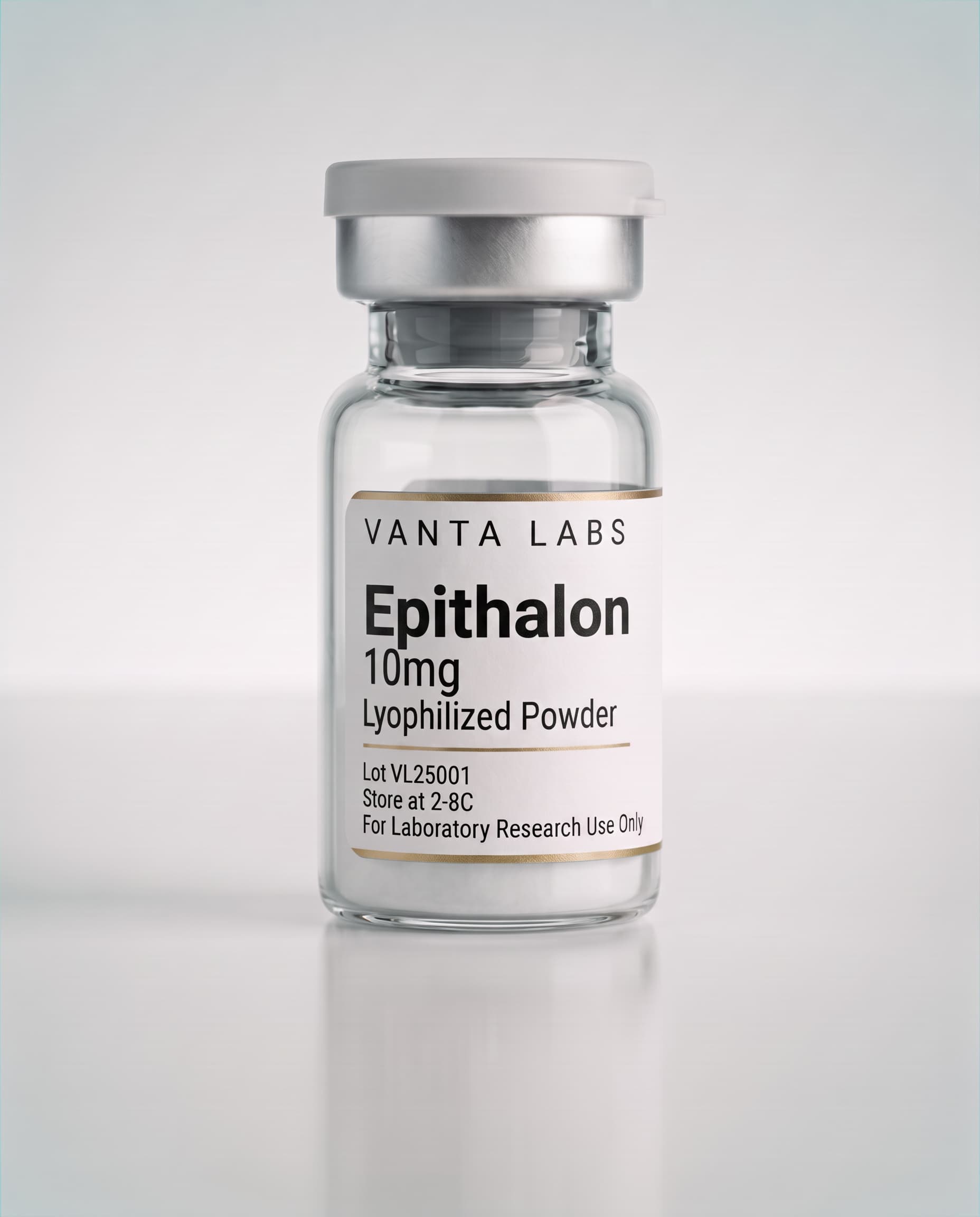
Vanta Labs lists Epithalon as a 10 mg vial of lyophilized powder, intended strictly for laboratory research use. The product listing identifies the free-base chemical form (see the molecular identity table above). The listing is labeled for laboratory research use only: not for human or veterinary use, not for diagnostic, therapeutic, or preventive use, and not accompanied by dosage or administration instructions.
Understanding the Epithalon Certificate of Analysis
Vanta Labs publishes batch-specific Certificates of Analysis (COAs) in its COA Library. The current Epithalon listing corresponds to batch Vanta184290, report KVR-2026-CC3A66, tested by Kovera Labs and certified 08/24/2026, with a reported purity of 99.816 percent. This figure describes the result for that specific documented batch and sample; it is not a guarantee about any other batch, and it is not evidence of sterility, endotoxin status, or suitability for any particular use. Researchers should always confirm that a COA's batch number matches the vial in hand before relying on its figures, and can verify this report directly by its report number and access code at koveralabs.com/verify.
HPLC vs. LC-MS: Understanding the Testing Difference
RP-HPLC. The reported purity figure above was generated using reversed-phase high-performance liquid chromatography (RP-HPLC) with a C18 column and diode-array detection at 214 nm. This method separates a sample's components chromatographically and reports purity as a percentage of the detected peak area; it is well suited to estimating relative purity but does not, on its own, confirm molecular identity or rule out sterility or endotoxin contamination.
LC-MS. Identity testing on this batch used liquid chromatography-mass spectrometry (LC-MS), which measures a sample's mass to compare against the expected molecular weight of the target compound. LC-MS supports identity confirmation; it answers a different question than a purity percentage and is not a substitute for it.
| Method | Main purpose | What it indicates | What it does not establish alone |
|---|---|---|---|
| RP-HPLC | Chromatographic separation | Reported purity percentage | Sterility, endotoxin status, or full molecular identity |
| LC-MS | Mass-based analysis | Identity consistent with expected mass | Sterility, endotoxin status, or general suitability for any use |
Understanding Batch-Specific Documentation and COA Limitations
A Certificate of Analysis is only meaningful when matched to the exact batch number on the vial being used; a report from a different batch cannot be substituted. Vanta Labs' published COAs for this product report purity (RP-HPLC) and identity (LC-MS) findings for the tested batch. They do not include sterility testing, endotoxin testing, residual-solvent testing, heavy-metal testing, or water-content testing, and readers should not assume those categories are covered unless a specific report states otherwise. The COA Library and the accompanying guide to reading a COA are the reference points for checking a specific lot before relying on it.
Common Research Clarifications
Is Epithalon the same as Epitalon? Epithalon and Epitalon are alternate spellings in common use for the same AEDG free-base tetrapeptide; the confusion arises because different laboratories, databases, and suppliers have historically used different transliterations. Confirm the exact chemical form (free base vs. acetate) referenced in any given source rather than assuming spelling alone settles identity (Araj et al., 2025).
Is Epithalon the same as Epithalamin? No. Epithalamin is a polypeptide complex extracted from bovine pineal tissue, while Epithalon is a single synthetic tetrapeptide developed based on Epithalamin's amino acid composition. The confusion arises because Epithalon was derived from Epithalamin research; however, their findings are not interchangeable (Vanta Labs product listing).
What does the AEDG sequence represent? AEDG is shorthand for the four amino acids in Epithalon's sequence: alanine, glutamic acid, aspartic acid, and glycine, in that order. It is not an abbreviation for a brand or trademark; it is the peptide's actual composition (PubChem CID 219042).
What is the molecular identity of Epithalon free base? The free-base form corresponds to CAS 307297-39-8, PubChem CID 219042, molecular formula C14H22N4O9, and molecular weight 390.35 g/mol. These are the identifiers listed on the current Vanta Labs product page (Vanta Labs product listing).
Is Epithalon acetate the same chemical form as Epithalon free base? No. Acetate and free-base forms carry different CAS numbers and molecular weights: the acetate form is CAS 307297-40-1 at 450.40 g/mol, against CAS 307297-39-8 at 390.35 g/mol for the free base. The FDA's 2026 review materials treated epitalon free base and epitalon acetate as separate bulk drug substances and noted an unresolved discrepancy between two acetate formula values in their own briefing materials, reinforcing that the two forms should not be treated as interchangeable (FDA briefing materials, 2026).
Why are telomere and telomerase studies not automatically human findings? Most published Epithalon telomere research has been conducted in cultured human cells (in vitro), which isolates specific cellular responses under laboratory conditions that do not replicate the full physiological complexity of a living organism. A finding in cultured cells is a starting point for further research, not a demonstrated human outcome (Khavinson et al., 2003).
What does research involving human cell lines actually establish? Cell-line research establishes how a compound affects specific measured endpoints, such as gene expression or telomere length, within that particular cell type and culture condition. It does not by itself establish safety, efficacy, or any outcome in a whole organism (Al-dulaimi et al., 2025).
Can animal or cell-culture research results be directly applied to humans? No single model's results can be assumed to transfer directly to humans. The human-related studies that do exist for Epithalon are small physiological and biomarker studies plus one methodologically limited controlled report; none amounts to an adequately powered randomized trial, so laboratory and small human-study findings should not be read as established clinical outcomes (Jain et al., 2026).
What does the 2025 telomere-related Epitalon publication investigate, and what correction was published? The 2025 Biogerontology paper by Al-dulaimi, Thomas, Matta, and Roberts investigated telomere length changes in several human cell lines, reporting telomerase upregulation in normal cells and ALT activity in cancer cells. A correction notice published in November 2025 replaced incorrect Figures 1, 2, and 3 in the original article; the correction did not retract the paper or invalidate its other reported findings, and both documents should be read together (Correction, 2025).
What does the reported 99.816% HPLC purity figure describe? That figure is the RP-HPLC-reported purity for one specific documented batch (Vanta184290, report KVR-2026-CC3A66) tested by Kovera Labs. It describes that batch and sample only; it is not a standing guarantee for future production runs and is not evidence of sterility or endotoxin status (Vanta Labs COA).
What can the LC-MS result establish, and what does it not establish? LC-MS identity testing compares a sample's measured mass against the expected mass of the target compound, supporting identity confirmation. It does not establish purity level, sterility, or endotoxin status; those require separate, dedicated testing methods (Vanta Labs Testing and Quality).
What does the published Epithalon COA not cover? The current batch-specific COA for this product reports RP-HPLC purity and LC-MS identity results. It does not include sterility testing, endotoxin testing, residual-solvent testing, heavy-metal testing, or water-content testing, and none of those categories should be assumed covered unless explicitly stated on the report (Vanta Labs COA Library).
Research Use Only and Documentation Limitations
Epithalon, as listed by Vanta Labs, is supplied strictly for laboratory research use. It is not intended for human or veterinary use, and no information in this article should be read as dosage, administration, or personal-use guidance. Researchers working with this compound should rely on the batch-matched Certificate of Analysis, the primary literature cited above, and their own institution's research protocols.
Frequently asked questions
What is Epithalon?
Epithalon is a synthetic linear tetrapeptide with the amino acid sequence Ala-Glu-Asp-Gly (AEDG), studied in laboratory and small human biomarker research related to telomerase activity, circadian biomarkers, and cellular aging pathways. It is also spelled Epitalon or Epithalone in the scientific literature. Epithalon is supplied strictly for laboratory research use and is not intended for human or veterinary use.
Is Epithalon the same as Epitalon?
Yes, in the sense that Epithalon and Epitalon are commonly used alternate spellings for the same AEDG free-base tetrapeptide across scientific papers, chemical databases, and research-compound listings. Always confirm the specific chemical form (free base or acetate) discussed in a given source rather than relying on spelling alone.
Is Epithalon the same as Epithalamin?
No. Epithalamin is a polypeptide complex extracted from bovine pineal tissue, while Epithalon is a single synthetic tetrapeptide developed based on Epithalamin's amino acid composition. Because they are chemically distinct, findings from Epithalamin research, including older cohort studies, should not be assumed to apply to synthetic Epithalon.
What is the Epithalon AEDG sequence?
AEDG stands for the four amino acids making up Epithalon's sequence, in order: alanine, glutamic acid, aspartic acid, and glycine. This sequence corresponds to CAS 307297-39-8 and PubChem CID 219042 in the free-base form listed on the current product page.
What is the difference between Epithalon free base and Epithalon acetate?
Free base and acetate are distinct chemical forms with different CAS numbers and molecular weights: the free base is CAS 307297-39-8 at 390.35 g/mol, and the acetate form is CAS 307297-40-1 at 450.40 g/mol, because the acetate carries bound acetate counter-ions. The identifiers listed for this product correspond specifically to the free-base form.
What is Epithalon studied for?
Published research on Epithalon has examined its proposed interactions with telomerase activity and telomere length in cultured human cells, gene-expression changes in stem-cell models, and circadian or melatonin-related biomarkers in a small number of human studies. These are research questions studied in specific models; they are not established health outcomes, and this article makes no benefit claims.
How is Epithalon investigated in telomere and telomerase research?
Researchers have added Epithalon to cultured human cells, such as telomerase-negative fibroblasts and other human cell lines, and measured changes in telomerase catalytic-subunit expression, telomerase enzymatic activity, and telomere length under controlled laboratory conditions. These are primarily in-vitro, cell-culture study designs.
Can Epithalon cell-study findings be applied directly to humans?
Not directly. Cell-culture findings describe what happens to cells in a laboratory dish under specific conditions. A small number of human biomarker studies and one methodologically limited controlled report exist for Epithalon, but a 2026 narrative review found no adequately powered randomized trial establishing efficacy, so cell-culture results should not be read as demonstrated human outcomes.
Is Epithalon FDA-approved?
No. Epithalon is not an approved drug. FDA staff's May 2026 briefing recommended against adding epitalon free base or acetate to the 503A compounding bulks list; the advisory committee's July 2026 vote in favor of inclusion is non-binding and is not an approval of any health claim or a final listing decision.
What should researchers check on an Epithalon Certificate of Analysis?
Confirm that the COA's batch number matches the vial in hand, check the certification date and testing laboratory, note which analytical methods were used (such as RP-HPLC for purity and LC-MS for identity), and check what the report does not cover, such as sterility or endotoxin testing, before relying on its figures.
What does the 99.816% Epithalon HPLC result mean?
The 99.816 percent figure is the RP-HPLC-reported purity for one specific documented batch, Vanta184290, report KVR-2026-CC3A66, tested by Kovera Labs. It reflects the chromatographic purity of that particular batch and sample only. It is not a standing guarantee for other batches and is not evidence of sterility, endotoxin status, or suitability for any particular use.
Which tests are not included in the published Epithalon COA?
The current batch-specific Certificate of Analysis reports RP-HPLC purity and LC-MS identity results only. It does not include sterility testing, endotoxin testing, residual-solvent testing, heavy-metal testing, or water-content testing. Researchers should not assume any of those categories are covered unless a specific report explicitly states otherwise.
Related products
Sources
- Khavinson VKh, Bondarev IE, Butyugov AA. Epithalon Peptide Induces Telomerase Activity and Telomere Elongation in Human Somatic Cells. Bulletin of Experimental Biology and Medicine, 2003.
- Al-dulaimi S, Thomas R, Matta S, Roberts T. Epitalon increases telomere length in human cell lines through telomerase upregulation or ALT activity. Biogerontology, 2025;26:178.
- Correction: Epitalon increases telomere length in human cell lines through telomerase upregulation or ALT activity. Biogerontology, 2025.
- Khavinson V, Diomede F, Mironova E, Linkova N, Trofimova S, Trubiani O, Caputi S, Sinjari B. AEDG Peptide (Epitalon) Stimulates Gene Expression and Protein Synthesis during Neurogenesis: Possible Epigenetic Mechanism. Molecules, 2020;25(3):609.
- Araj SK, Brzezik J, Madra-Gackowska K, Szeleszczuk L. Overview of Epitalon, Highly Bioactive Pineal Tetrapeptide with Promising Properties. International Journal of Molecular Sciences, 2025;26(6):2691.
- Jain A, Gallacher DM, Issa MA, Deer TR, Yong RJ, Diwan S, Lee W, Sayed D, Amirdelfan K, Robinson CL. Epitalon and Epithalamin in Regenerative and Longevity Medicine: Mechanisms, Evidence, and Translational Gaps. International Journal of Molecular Sciences, 2026;27(19):8922.
- FDA. Briefing Document: Epitalon (Free Base) and Epitalon Acetate, Pharmacy Compounding Advisory Committee Meeting, May 12, 2026.
- FDA. Pharmacy Compounding Advisory Committee Meeting Materials, July 23-24, 2026 (includes epitalon acetate identifiers).
- FDA. July 23-24, 2026 Meeting of the Pharmacy Compounding Advisory Committee.
- FDA. Bulk Drug Substances Used in Compounding Under Section 503A of the FD&C Act.
- PubChem. Compound Summary for CID 219042, Epitalon.
- Vanta Labs. Epithalon product listing.
- Vanta Labs. Certificate of Analysis, batch Vanta184290, report KVR-2026-CC3A66.
- Vanta Labs. COA Library.
- Vanta Labs. How to Read a Certificate of Analysis.
- Vanta Labs. Testing and Quality.