CJC-1295 + Ipamorelin: No-DAC Research Guide
By Vanta Labs Research teamPublished 11 min read
A documentation-focused look at the Vanta Labs CJC-1295 + Ipamorelin research blend: its No-DAC CJC-1295 identity, 5 mg plus 5 mg composition, and what its Certificate of Analysis does and does not establish.
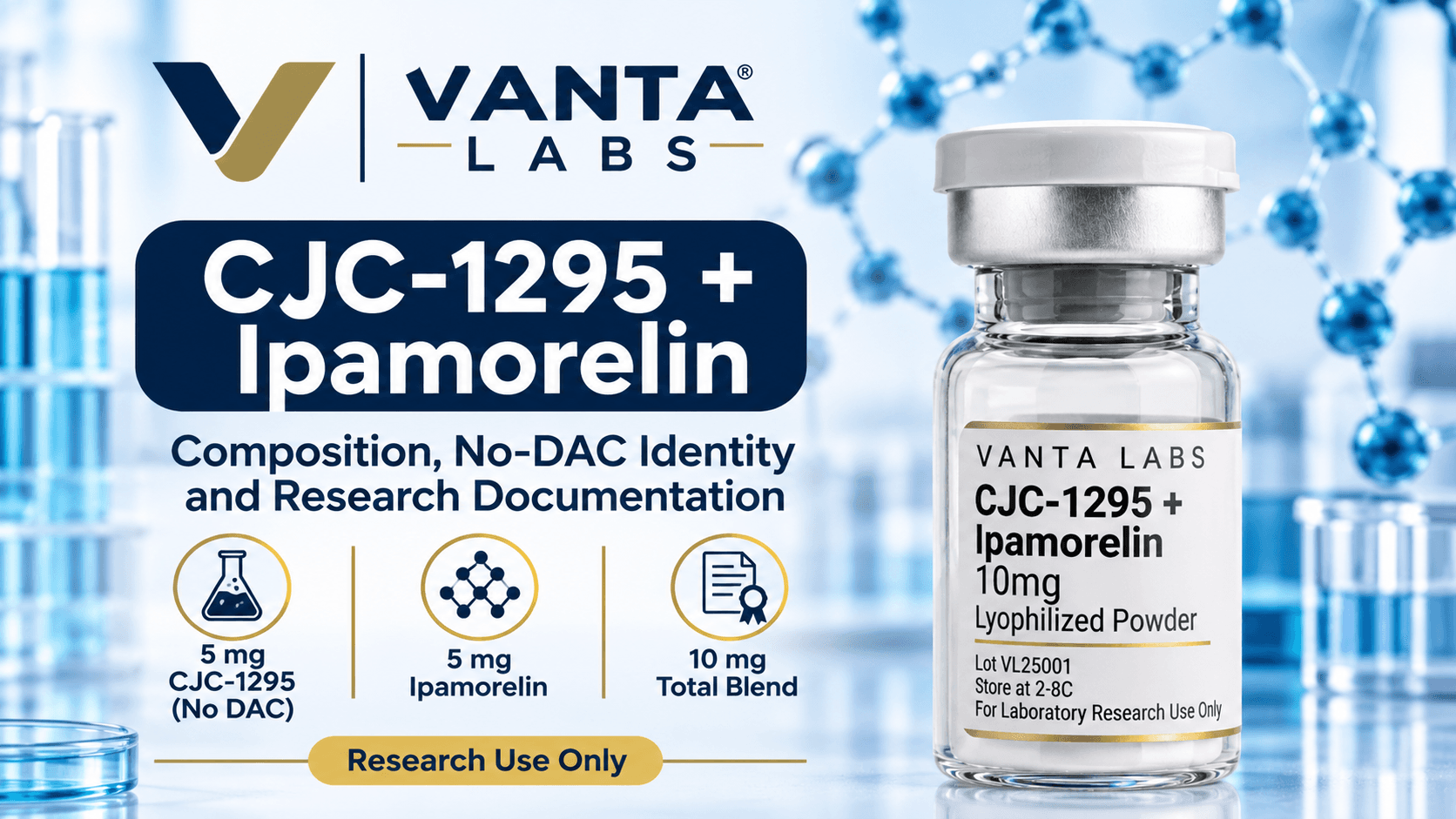
# CJC-1295 + Ipamorelin: Composition, No-DAC Identity and Research Documentation
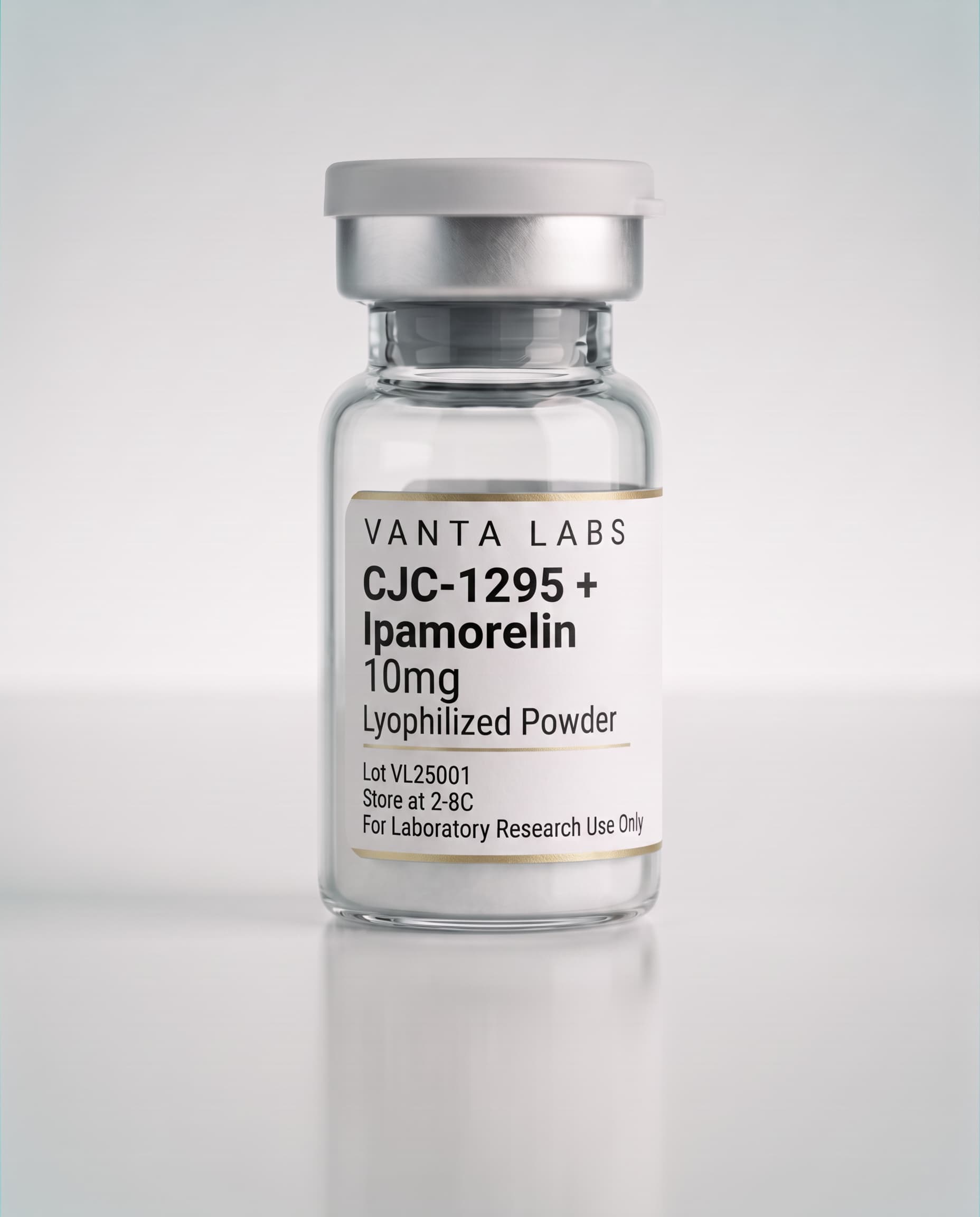
The Vanta Labs CJC-1295 + Ipamorelin blend is a two-component research peptide product supplied as a single vial of lyophilized powder. The labelled composition is 5 mg of CJC-1295 in its No-DAC form plus 5 mg of Ipamorelin, for a total of 10 mg (Vanta Labs product listing). The product is intended strictly for laboratory research use, not human or veterinary use, and this article does not address dosing, reconstitution, or administration. The sections below cover what the listing identifies, the DAC versus No-DAC distinction, the scientific classification of each peptide, and what the published Certificate of Analysis (COA) does and does not establish.
What Is the CJC-1295 + Ipamorelin Research Blend?
The product is listed under the name CJC-1295 + Ipamorelin, with the CJC-1295 component specifically documented as the No-DAC form (Vanta Labs product listing). It combines two separately labelled peptide components into one lyophilized powder fill rather than two separate products. A combined vial of this kind is a physical blend of two distinct molecules, not a single new compound with its own identity. Because the two components carry different classifications, research histories, and documented quantities, the exact wording of the listing and its supporting documentation matters more than the shorthand name "CJC-1295 + Ipamorelin" by itself.
CJC-1295 and Ipamorelin Blend Composition
| Component | Labelled quantity |
|---|---|
| CJC-1295 (No DAC) | 5 mg |
| Ipamorelin | 5 mg |
| Total blend | 10 mg |
The 10 mg figure is the sum of the two components, not the amount of either one individually (batch COA KVR-2026-6AA733). The product listing does not assign the combined blend a single shared CAS number or molecular weight. Ipamorelin's own published identifiers (CAS 170851-70-4; PubChem CID 9831659, molecular formula C38H49N9O5) describe Ipamorelin alone, not the blend as a unit (PubChem Compound Summary for CID 9831659, https://pubchem.ncbi.nlm.nih.gov/compound/9831659).
Understanding CJC-1295 and the No-DAC Distinction
CJC-1295 is classified in the scientific literature as an analogue of growth hormone-releasing hormone (GHRH), built on the GHRH peptide backbone with modifications intended to change its stability. Two distinct forms are discussed under that name: a DAC form, carrying a Drug Affinity Complex linker that binds to circulating albumin, and a No-DAC form, which lacks that linker (Teichman et al., 2006; Vanta Labs product listing).
Vanta Labs' own product FAQ refers to the No-DAC component as "Modified GRF (1-29)." That naming comes from the product's FAQ itself, not from an independently published, batch-specific sequence confirmation; the documentation does not publish a standalone amino-acid sequence or a separately verified chemical identity for this component beyond that FAQ naming. Researchers should treat "Modified GRF (1-29)" as the manufacturer's own terminology, not an independently cited molecular identity for this batch.
Published pharmacokinetic data specific to the DAC-bearing form, including the multi-day plasma half-life Teichman et al. (2006) reported in connection with its albumin-binding linker, describes that DAC molecule only. This article cites no equivalent peer-reviewed half-life figure for the No-DAC component, and no pharmacokinetic claim from the DAC literature should be read as describing the No-DAC peptide in this blend.
Understanding Ipamorelin and Its Scientific Classification
Ipamorelin is described in the literature as a synthetic pentapeptide, sequence Aib-His-D-2-Nal-D-Phe-Lys-NH2, first characterized by Raun et al. (1998) in the European Journal of Endocrinology as a selective growth hormone secretagogue. That paper and the compound's PubChem record (CID 9831659) classify Ipamorelin within the ghrelin-receptor research context, acting at the growth hormone secretagogue receptor, specifically GHS-R1a, the receptor family endogenous ghrelin engages (Raun et al., 1998; PubChem CID 9831659). This places Ipamorelin in a different pharmacological category from a GHRH analogue like CJC-1295, since the two peptides act through separate receptor systems.
These references establish nomenclature and receptor classification for Ipamorelin as a compound; neither, on its own, establishes the identity or purity of the specific Ipamorelin content in this manufactured batch, which depends on batch-specific analytical testing covered later in this article.
GHRH Receptor and Ghrelin Receptor Research
GHRH Receptor Classification
CJC-1295 is classified as a GHRH analogue, grouping it with compounds structurally related to growth hormone-releasing hormone and studied in connection with the GHRH receptor (Teichman et al., 2006).
Ghrelin Receptor Classification
Ipamorelin is classified as a ghrelin-receptor research peptide, studied in connection with the growth hormone secretagogue receptor family, GHS-R and GHS-R1a specifically (Raun et al., 1998).
Distinguishing the Two Research Classifications
A GHRH analogue and a ghrelin-receptor peptide represent two distinct research classifications tied to two separate receptor systems. Combining two peptides from different classifications in one vial does not merge their classifications into a single category, and it does not by itself establish any combined research outcome.
Why CJC-1295 DAC and No-DAC Should Not Be Confused
DAC and No-DAC are not interchangeable labels for the same substance; they describe chemically distinct molecules sharing a common GHRH-analogue backbone. The Vanta Labs batch documentation for this product specifies the No-DAC form (batch COA KVR-2026-6AA733). Because published DAC studies, including Teichman et al. (2006), describe a structurally different molecule, DAC-specific findings, such as the DAC half-life figures discussed in that paper, cannot be used to substantiate claims about this product's No-DAC component.
Understanding the CJC-1295 + Ipamorelin Certificate of Analysis
The published documentation identifies batch Vanta184290, COA report KVR-2026-6AA733, issued by Kovera Labs and dated 08/24/2026. That report lists a 10 mg labelled blend composed of 5 mg CJC-1295 (No DAC) and 5 mg Ipamorelin, with a reported blend average purity of 99.459% by reversed-phase HPLC and identity confirmation by LC-MS (batch COA KVR-2026-6AA733). The report can be verified directly by its report number and access code at koveralabs.com/verify.
This 99.459% figure is a blend-level result, not an independently reported purity figure for CJC-1295 or Ipamorelin separately. Researchers should confirm the batch number on their own vial against the specific COA document, since the Vanta Labs COA Library lists batch Vanta184290 against multiple unrelated products, making the batch number alone a weak identifier (Vanta Labs COA Library).
RP-HPLC vs LC-MS: Understanding the Analytical Difference
RP-HPLC Testing
Reversed-phase high-performance liquid chromatography (RP-HPLC) separates the components of a sample as they pass through a column, producing chromatographic peaks. Analysts calculate a purity figure from the relative area of those peaks at a specified detection wavelength. This characterizes what elutes as a distinct peak, which is not the same as confirming the absence of impurities behaving similarly under the same conditions.
LC-MS Identification
Liquid chromatography-mass spectrometry (LC-MS) couples chromatographic separation with a mass measurement, letting analysts compare the measured mass of a separated component against the expected mass of the target molecule. This supports an identity finding, that the detected compound is consistent with the expected molecular identity, a distinct question from how pure that compound is.
RP-HPLC vs LC-MS Comparison
| Analytical method | Primary purpose | What it can indicate | What it does not establish alone |
|---|---|---|---|
| RP-HPLC | Chromatographic separation | Reported chromatographic purity | Sterility or complete molecular identity |
| LC-MS | Mass-based analysis | Identity findings within the reported method | Sterility, endotoxin status, or suitability for human or veterinary use |
Neither method, on its own, establishes every quality characteristic a researcher might want to know about a sample.
Understanding Batch-Specific Documentation
Analytical results are specific to the batch tested; a report dated for one production run does not describe a later or earlier run. Researchers can locate the published report for a given batch through the Vanta Labs COA Library and should confirm the batch number and composition on their own vial match the specific report under review, rather than assuming a shared batch number applies. Composition, testing dates, and reported figures can change between batches, so historical results should not be read forward onto runs not yet separately tested and published.
Common Questions About This Documentation, Clarified
1. What exactly does the Vanta Labs listing identify? Why the confusion occurs: the short name "CJC-1295 + Ipamorelin" omits the No-DAC detail. Clarification: a two-component research blend of CJC-1295, No-DAC form (5 mg), and Ipamorelin (5 mg), as 10 mg of lyophilized powder in one vial, for laboratory research only (Vanta Labs product listing).
2. Does the 10 mg label mean 10 mg of each component? Why the confusion occurs: a single figure on a two-peptide label can read as applying to each one. Clarification: 10 mg is the combined total of 5 mg CJC-1295 (No DAC) plus 5 mg Ipamorelin, not 10 mg of each (batch COA KVR-2026-6AA733).
3. How much CJC-1295 and Ipamorelin does the blend contain individually? Why the confusion occurs: blends are sometimes described only by combined weight. Clarification: the documented split is 5 mg CJC-1295 (No DAC) and 5 mg Ipamorelin (Vanta Labs product listing).
4. Is the CJC-1295 in the blend the DAC or No-DAC form? Why the confusion occurs: "CJC-1295" is used colloquially for either form. Clarification: the documented component is the No-DAC form, which Vanta Labs' own FAQ names "Modified GRF (1-29)," a manufacturer naming, not an independently published sequence confirmation for this batch.
5. Why is CJC-1295 No-DAC not interchangeable with the DAC designation? Why the confusion occurs: both forms share the "CJC-1295" name and a GHRH-analogue backbone. Clarification: the DAC form carries an albumin-binding linker; published pharmacokinetic data for it (Teichman et al., 2006) describes that molecule only, not the No-DAC component's own pharmacokinetics.
6. What does the GHRH analogue classification mean? Why the confusion occurs: "analogue" can read as a vague marketing term. Clarification: a compound structurally related to growth hormone-releasing hormone, studied at the GHRH receptor; a nomenclature and research classification, not a description of any outcome.
7. What does the ghrelin-receptor peptide classification mean? Why the confusion occurs: Ipamorelin is sometimes grouped loosely as a "growth peptide." Clarification: classified as acting at the growth hormone secretagogue receptor, GHS-R1a, the receptor family endogenous ghrelin engages (Raun et al., 1998).
8. Does the combined blend have one shared molecular formula or molecular weight? Why the confusion occurs: one vial can suggest the two peptides form a single new molecule. Clarification: no. The listing assigns no shared CAS number or molecular weight; each component keeps its own published identifiers (PubChem CID 9831659).
9. What does the 99.459% HPLC result actually represent? Why the confusion occurs: one purity figure on a two-component product can read as covering each peptide. Clarification: the reported blend-level average purity from RP-HPLC testing of the combined product, not a separate figure for either peptide (batch COA KVR-2026-6AA733).
10. Does the blend's COA establish separate purity results for both components? Why the confusion occurs: a two-component product might be expected to carry two purity figures. Clarification: the report gives one blend-level purity figure; it does not divide that figure between the two peptides (batch COA KVR-2026-6AA733).
11. What does LC-MS identity testing establish, and what are its limitations? Why the confusion occurs: "tested" is sometimes read as covering every quality measure. Clarification: a finding that the detected compound's mass is consistent with the expected molecule; it does not, alone, establish sterility, endotoxin status, or suitability for any use.
12. Which testing categories are not covered by the published report? Why the confusion occurs: a COA can appear comprehensive at a glance. Clarification: Vanta Labs' own guidance states its published reports test for neither sterility, endotoxins, residual solvents, heavy metals, nor water content; silence on a test gives no information either way (Vanta Labs, "How to Read a COA").
Research Use Only and Documentation Limitations
This product is labelled strictly for laboratory research use, not for human consumption, veterinary use, or the diagnosis, treatment, cure, or prevention of any condition. This article provides no dosing, reconstitution, injection, or other personal-use guidance. The published COA addresses purity (RP-HPLC) and identity (LC-MS) only; per Vanta Labs' own guidance, its reports do not test for sterility, endotoxins, residual solvents, heavy metals, or water content, and silence on those points is not evidence either way. Researchers should review the current listing and batch-specific COA directly, since documentation can be updated or superseded by later testing.
Frequently asked questions
What is the CJC-1295 + Ipamorelin research blend?
It is a two-component research peptide product from Vanta Labs, combining CJC-1295 in its No-DAC form with Ipamorelin in a single vial of lyophilized powder. The documented composition is 5 mg CJC-1295 (No DAC) plus 5 mg Ipamorelin, for a total labelled amount of 10 mg. The product is intended strictly for laboratory research use and carries no human or veterinary use claims.
What does the Vanta Labs CJC-1295 + Ipamorelin vial contain?
The vial contains 10 mg total of lyophilized powder, made up of two documented components: 5 mg of CJC-1295 in its No-DAC form and 5 mg of Ipamorelin. The two components are combined into one powder fill at manufacture rather than supplied as separate vials, per the batch Certificate of Analysis KVR-2026-6AA733.
How much CJC-1295 and Ipamorelin is in the 10 mg blend?
The published documentation lists 5 mg of CJC-1295 (No DAC) and 5 mg of Ipamorelin, which together make up the 10 mg total labelled amount reported on batch Vanta184290. Neither component is present at 10 mg individually; the figure on the label always refers to the combined weight of both peptides.
Is the CJC-1295 in this blend the DAC or No-DAC form?
It is the No-DAC form. Vanta Labs' own product FAQ refers to this component as Modified GRF (1-29), though that naming comes from the manufacturer's FAQ rather than an independently published sequence confirmation for this specific batch. The product and batch documentation should not be read as describing CJC-1295 with DAC.
What is the difference between CJC-1295 DAC and No DAC?
CJC-1295 with DAC carries a Drug Affinity Complex linker that binds to albumin, and published pharmacokinetic data from Teichman et al. (2006) describes an extended plasma half-life for that linked form specifically. That paper does not characterize the No-DAC form, so no equivalent half-life figure from it should be applied to this product's No-DAC component.
Is CJC-1295 + Ipamorelin supplied as lyophilized powder?
Yes. The product is supplied as a lyophilized powder fill in a single vial, combining both documented components at the labelled 5 mg plus 5 mg split. This article covers documentation and classification only; it does not cover reconstitution or handling procedures for the powder.
Does the blend have its own Certificate of Analysis?
Yes. The product's documented batch, Vanta184290, has a published COA, report KVR-2026-6AA733, issued by Kovera Labs and dated 08/24/2026. That report covers the combined 10 mg blend as a single tested product rather than reporting on each peptide component separately.
What does the 99.459% reported HPLC result describe?
It is the reported blend-level average purity from RP-HPLC testing of the combined 10 mg product, as listed on COA report KVR-2026-6AA733. It is not an independently reported purity figure for CJC-1295 or Ipamorelin considered on its own, and the report does not divide that percentage between the two components.
What does LC-MS testing indicate in the published batch report?
LC-MS identity testing indicates that the mass of the detected compound is consistent with the expected molecular identity for the tested sample. It addresses identity, not purity, and it does not, on its own, confirm sterility, endotoxin status, or suitability for any particular use beyond laboratory research.
Why must the blend COA be distinguished from standalone component COAs?
A standalone CJC-1295 COA or a standalone Ipamorelin COA measures that single compound alone and is not a substitute for the blend-specific report. The combined-product COA, KVR-2026-6AA733, reflects testing of the two-component mixture exactly as supplied, which is the document relevant to this particular vial.
What does Research Use Only mean for this product?
Research Use Only means the product is intended strictly for laboratory research and is not intended for human consumption, veterinary use, or the diagnosis, treatment, cure, or prevention of any condition. No dosing, reconstitution, or administration guidance is provided for a Research Use Only product, and none should be inferred from this article.
Is the CJC-1295 + Ipamorelin product an FDA-approved medicine?
No. Neither CJC-1295 nor ipamorelin is an FDA-approved drug. Both were previously nominated for Category 2 of the FDA's interim 503A Bulks List; the FDA removed both from Category 2 effective September 27, 2024, following withdrawn nominations, and a subsequent Pharmacy Compounding Advisory Committee review on October 29, 2024 recommended against adding ipamorelin to that list. Removal from Category 2 reflects a withdrawn nomination, not FDA approval, clearance, or a safety finding. Regulatory status can change, so researchers should re-verify against current official FDA sources before relying on this answer.
Related products
Sources
- Vanta Labs, CJC-1295 + Ipamorelin product listing
- Vanta Labs, Certificate of Analysis Library
- Vanta Labs, "How to Read a COA"
- Vanta Labs, Testing and Quality
- Raun K, Hansen BS, Johansen NL, et al. Ipamorelin, the first selective growth hormone secretagogue. European Journal of Endocrinology. 1998;139(5):552-561.
- Teichman SL, Neale A, Lawrence B, et al. Prolonged stimulation of growth hormone and insulin-like growth factor I secretion by CJC-1295, a long-acting analog of GH-releasing hormone, in healthy adults. Journal of Clinical Endocrinology and Metabolism. 2006;91(3):799-805.
- National Center for Biotechnology Information, PubChem Compound Summary for CID 9831659, Ipamorelin
- U.S. Food and Drug Administration, notice removing CJC-1295, ipamorelin acetate and others from Category 2 of the Interim 503A Bulks List
- U.S. Food and Drug Administration, Pharmacy Compounding Advisory Committee briefing/vote record, October 29, 2024, re: ipamorelin