GLP-2 (TR) Research Peptide: Naming and Classification
By Vanta Labs Research teamPublished 9 min read
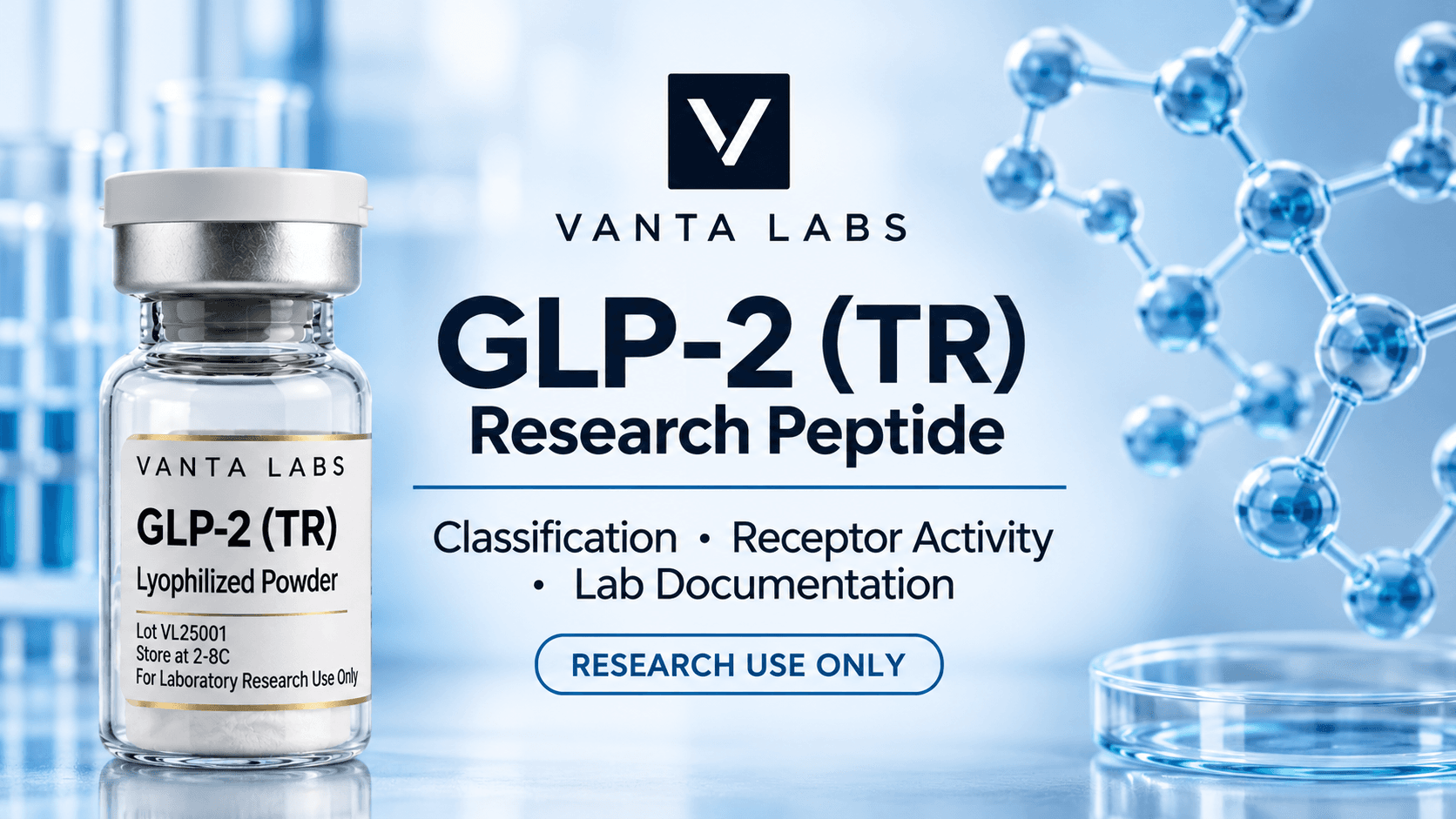
GLP-2 (TR) research peptide is Vanta Labs' product label for a peptide studied for agonist activity at the GIP and GLP-1 receptors, not the GLP-2 receptor the name suggests. This guide separates what the documentation actually establishes from what the label alone implies.
Why GLP-2 (TR)'s Name Creates Confusion Before the Science Even Starts
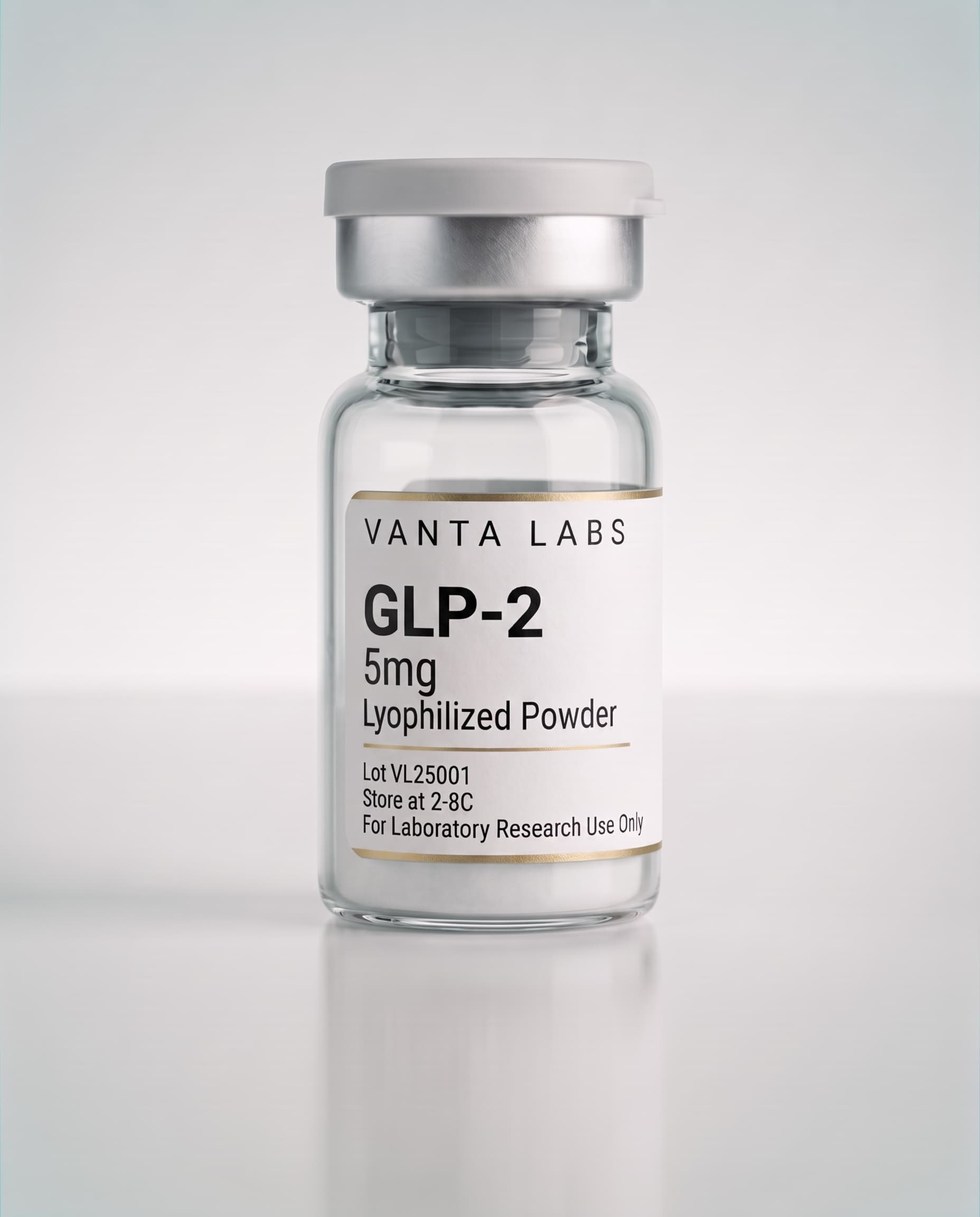
GLP-2 (TR) is the product name and SKU label Vanta Labs uses for a synthetic peptide listed on its research-chemical catalog. On the product page, Vanta Labs describes GLP-2 (TR) as a synthetic research peptide studied for agonist activity at the GIP and GLP-1 receptors. The listing describes the product as a lyophilized powder supplied in four vial sizes: 5 mg, 10 mg, 20 mg, and 30 mg.
The confusion starts with the letters in the name itself. "GLP-2" is also the name of a real, naturally occurring peptide hormone with its own receptor. A reader who sees "GLP-2 (TR)" and assumes it must act on the GLP-2 receptor is making a reasonable-sounding guess based on the label alone, not on what the documentation actually states. This article exists to separate the product label from the receptor science, clearly and without filling gaps with assumptions.
GIP, GLP-1 and GLP-2: Three Distinct Hormones and Receptors
Three peptide names get used in and around this topic, and they are easy to blur together: GIP, GLP-1, and GLP-2.
GIP (glucose-dependent insulinotropic polypeptide) and GLP-1 (glucagon-like peptide-1) are classified in the research literature as incretin hormones, gut-derived peptides studied for their roles in the body's response to nutrient intake, each acting through its own dedicated receptor (GIPR and GLP-1R) (Seino Y, Fukushima M, Yabe D, PubMed). GLP-2 (glucagon-like peptide-2) is a separate peptide that, like GLP-1, is produced from the same precursor protein in the intestine, but it signals through its own distinct receptor, GLP-2R, and is studied in a different area of research from GIP and GLP-1.
These three names describe three different molecules and three different receptors. None of this changes if a supplier chooses to use one of these names, or a close variant of one, as part of a product label.
What Vanta Labs' Documentation States About GLP-2 (TR)'s Receptor Activity
Vanta Labs describes GLP-2 (TR) as a synthetic research peptide studied for agonist activity at the GIP and GLP-1 receptors. That is the exact scope of the receptor-activity claim made on the current product listing. It is not described there as acting on the GLP-2 receptor.
This distinction answers one of the most common questions about this product directly: is GLP-2 (TR) a GLP-2 receptor agonist? The published Vanta Labs listing identifies GIP and GLP-1 receptor activity. It does not identify GLP-2 receptor activity. Readers should rely on that documented classification rather than on the product name alone.
Why a Supplier Statement Is Not an Independent Receptor Assay Result
It is worth being precise about what the sentence above actually establishes. "Vanta Labs describes GLP-2 (TR) as a synthetic research peptide studied for agonist activity at the GIP and GLP-1 receptors" is a report of what the supplier's own listing says. It is not, on its own, the same as an independently published, peer-reviewed receptor-binding or functional assay result for this specific batch of material.
That is not a criticism of the listing; it is simply a distinction that matters for anyone citing this product in their own research notes or writing about it accurately. A supplier's product description and an independently verified assay result are two different kinds of evidence, and this article treats them as such throughout, attributing receptor-activity statements to Vanta Labs' own documentation rather than presenting them as independently confirmed laboratory findings.
Dual GIP/GLP-1 Receptor Agonism as a Scientific Classification
"Dual GIP and GLP-1 receptor agonist" is a research classification describing a molecule reported to activate two separate receptor targets, the GIP receptor and the GLP-1 receptor, rather than only one. This classification is well established in the published literature in connection with other, independently identified compounds, including tirzepatide, which has been characterized in peer-reviewed reviews as a dual-acting GIP and GLP-1 receptor agonist (NCBI review).
GLP-2 (TR)'s documented receptor-activity description, dual activity at the GIP and GLP-1 receptors, places it in this same general classification as reported by its supplier. That shared classification is useful scientific context for understanding the terminology. It is a separate question from whether GLP-2 (TR) and any specific, independently identified compound share an identical chemical structure, which the next two sections address directly.
Why Receptor Classification and Molecular Identity Are Two Different Questions
Receptor classification describes a function: which receptor or receptors a molecule is reported to engage. Molecular identity describes a structure: the exact sequence of atoms or amino acid residues that make up the molecule. These are two different kinds of information, and one does not substitute for the other.
As of the current listing, the Vanta Labs product page does not publish a CAS registry number, a nonproprietary chemical name, a molecular formula, or an amino acid sequence for GLP-2 (TR). A shared or similar receptor-activity description does not, by itself, confirm that a research peptide has a specific, independently published chemical structure. Confirming exact identity requires molecular-level documentation (a verified CAS number, sequence, or formula) in addition to, not instead of, the functional receptor classification reported on the product page.
Why GLP-2 (TR) Should Not Be Equated With Tirzepatide Without Direct Evidence
Because GLP-2 (TR)'s reported receptor activity (dual GIP and GLP-1 agonism) matches the general target class associated with tirzepatide in the published literature, it is tempting to treat the two names as interchangeable. The current Vanta Labs documentation does not support that step.
Tirzepatide is an independently identified compound with a published chemical structure and an extensive literature base built around that specific, confirmed identity. GLP-2 (TR), as currently documented by Vanta Labs, has a reported receptor classification but no published CAS number, chemical name, molecular formula, or amino acid sequence. A receptor classification shared with tirzepatide in the general research literature is not evidence that GLP-2 (TR) is tirzepatide. Research notes, citations, and internal documentation should keep these as two separate entries until Vanta Labs' own product documentation independently confirms otherwise.
How In Vitro Research Characterizes Receptor-Targeting Peptides, in General Terms
In the published literature, dual GIP/GLP-1 receptor agonists as a class are typically characterized through in vitro research models, including receptor-binding assays and cell-based functional assays that measure how strongly a compound activates a given receptor under controlled laboratory conditions (NCBI review). This is general background on how this class of molecule is studied in the field; it describes research methodology in general terms rather than any specific finding for GLP-2 (TR) itself.
This article does not provide, and this product is not supplied with, any protocol for administering GLP-2 (TR) to a human or animal subject. Laboratory work with this material should be designed and conducted by qualified personnel under their own institution's research and safety policies.
Reading a Peptide's Analytical Testing: Purity vs. Identity
Vanta Labs' documentation for the current batch, published in the COA library, reports purity by RP-HPLC (reversed-phase high-performance liquid chromatography) and identity confirmation by LC-MS (liquid chromatography-mass spectrometry).
These two methods answer two different questions. RP-HPLC purity testing measures how much of the sample consists of the intended compound relative to other detectable substances. LC-MS identity testing helps confirm that the detected compound is consistent with its expected molecular mass. Neither test, alone or together, establishes biological activity, sterility, or overall suitability for any particular use; each describes the sample's measured composition by that specific method, on that specific date, for that specific batch.
Why Batch-Specific Certificates Matter, Vial by Vial
The current batch, Vanta184290, certified 08/24/2026 by Kovera Labs, carries four separate, vial-size-specific purity reports: 99.581% (5 mg, report KVR-2026-877D23), 99.708% (10 mg, report KVR-2026-D52918), 99.439% (20 mg, report KVR-2026-FDA407), and 99.874% (30 mg, report KVR-2026-01E336), all published in the COA library.
These figures should not be averaged, rounded into a single "product purity" figure, or assumed to apply to a vial size other than the one tested. A result tied to one vial size and one batch describes that vial size and that batch. A future batch, even of the same product, would carry its own, separately generated Certificate of Analysis. Each of the four reports above can be checked directly at koveralabs.com/verify using its report number and access code.
What Lyophilization Means, and What It Does Not Promise
GLP-2 (TR) is supplied as a lyophilized powder. Lyophilization is a freeze-drying process: water is removed from the sample under vacuum at low temperature, leaving a dry powder.
That is the full scope of what "lyophilized" describes here. It is a statement about how the material was processed and is presented, not a statement about storage stability, shelf life, or suitability for any particular use. Researchers should rely on the supplier's own handling and storage documentation rather than on general assumptions about lyophilized materials.
What "Research Use Only" Actually Limits
GLP-2 (TR) is classified by Vanta Labs as for laboratory research use only. It is not a drug, food, cosmetic, or dietary supplement, and it is not intended to diagnose, treat, cure, or prevent any condition. It is not intended for human or veterinary use.
This classification distinguishes a material like GLP-2 (TR) from an approved pharmaceutical product, which goes through formal regulatory review, clinical testing, and approved labeling for a specific indication before reaching patients. Readers researching the dual GIP/GLP-1 receptor agonist class in the approved-drug literature should keep this distinction in mind: published findings about an approved, independently identified drug describe that drug, under its own regulatory approval, and do not transfer to a research-only product whose exact chemical identity has not been independently confirmed by its own supplier.
Frequently asked questions
What is GLP-2 (TR)?
GLP-2 (TR) is the product name Vanta Labs uses for a synthetic peptide supplied as a lyophilized powder in 5 mg, 10 mg, 20 mg, and 30 mg vials. Vanta Labs describes it as a research peptide studied for agonist activity at the GIP and GLP-1 receptors. It is sold strictly for laboratory research use.
Is GLP-2 (TR) a GLP-2 receptor agonist?
The published Vanta Labs listing identifies GIP and GLP-1 receptor activity. It does not identify GLP-2 receptor activity.
Why does the name "GLP-2 (TR)" sound like it should relate to the GLP-2 receptor?
The letters "GLP" appear in both the product label and in GLP-2, the naturally occurring hormone with its own distinct receptor. The two are separate: a product name is a catalog label chosen by the supplier, not a scientific statement about which receptor a compound engages. The listed receptor activity for GLP-2 (TR) is GIP and GLP-1, not GLP-2.
What is the difference between GIP, GLP-1, and GLP-2?
GIP (glucose-dependent insulinotropic polypeptide), GLP-1 (glucagon-like peptide-1), and GLP-2 (glucagon-like peptide-2) are three distinct peptide hormones, each acting through its own dedicated receptor (GIPR, GLP-1R, and GLP-2R respectively). GIP and GLP-1 are classified as incretin hormones. GLP-2 is a separate peptide derived, like GLP-1, from proglucagon, but it signals through a different receptor.
What does "dual GIP and GLP-1 receptor agonist" mean?
It is a research classification for a molecule described as capable of activating two separate receptor targets, the GIP receptor and the GLP-1 receptor, rather than only one. The term describes receptor-level activity as reported by a supplier or in research literature, and it does not, on its own, describe or imply any outcome in a living organism.
Is GLP-2 (TR) the same as Tirzepatide?
Not according to current Vanta Labs documentation. The product page does not publish a CAS number, chemical name, molecular formula, or amino acid sequence confirming GLP-2 (TR)'s exact chemical identity. A shared receptor-activity description is not, by itself, proof that two materials are chemically identical. Treat GLP-2 (TR) and tirzepatide as distinct until the supplier's own documentation independently confirms otherwise.
Does Vanta Labs publish a CAS number or amino acid sequence for GLP-2 (TR)?
No. As of the current listing, Vanta Labs has not published a CAS registry number, chemical name, molecular formula, or amino acid sequence for this specific product.
What does "lyophilized powder" mean?
Lyophilized means freeze-dried. The peptide is supplied as a dry powder with water removed under vacuum at low temperature.
Does each GLP-2 (TR) vial size have its own Certificate of Analysis?
Yes. The current batch has a separate, vial-size-specific purity report for each of the 5 mg, 10 mg, 20 mg, and 30 mg sizes, each with its own report number, published in the COA library. A result for one vial size should not be assumed to apply to another vial size or to a future batch.
Is GLP-2 (TR) intended for human or veterinary use?
No. The product is supplied for laboratory research use only. It is not a drug, food, cosmetic, or dietary supplement, and it is not intended to diagnose, treat, cure, or prevent any condition in humans or animals.
Related products
Sources
- Vanta Labs, GLP-2 (TR) GIP/GLP-1 Agonist Research Peptide product page
- Vanta Labs, Certificate of Analysis Library
- Kovera Labs, report verification portal
- Seino Y, Fukushima M, Yabe D. GIP and GLP-1, the two incretin hormones: Similarities and differences
- PubMed, referenced research on incretin receptor biology
- National Library of Medicine (PMC), review of GIP/GLP-1 receptor co-agonism research
- National Library of Medicine (PMC), review of tirzepatide's dual GIP/GLP-1 receptor mechanism of action