GLP-3 (RT): Understanding Triple Agonist Peptide Research
By Vanta Labs Research teamPublished 11 min read
A research overview of Vanta Labs' GLP-3 (RT) listing: what the product label does and does not establish, how triple receptor agonism is studied, and what the current documentation discloses.
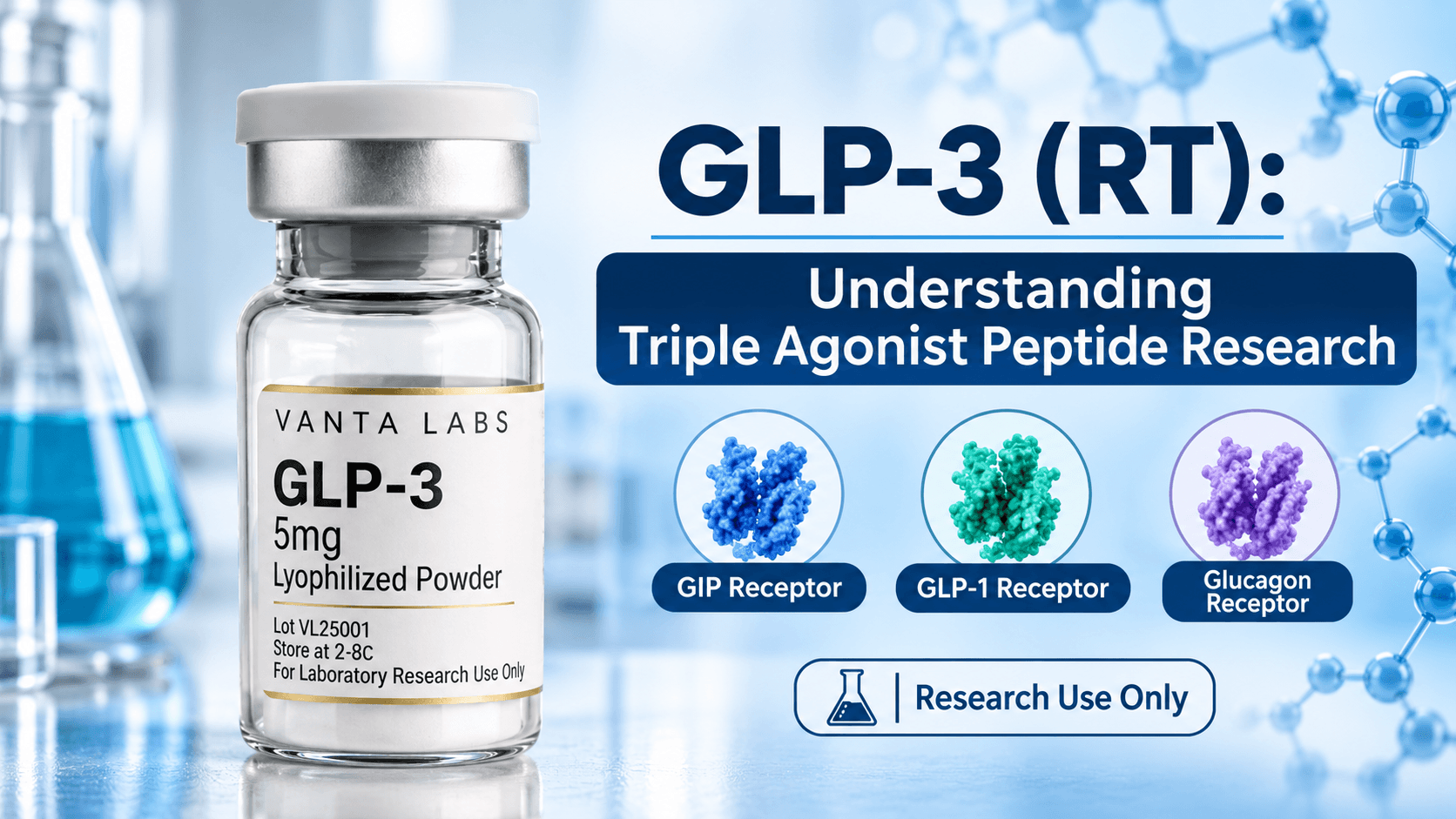
# GLP-3 (RT): Understanding Triple Agonist Peptide Research
GLP-3 (RT) is the product name Vanta Labs uses for a synthetic peptide listed as studied for agonist activity at the GIP, GLP-1, and glucagon receptors. The name refers to a catalog label, not to an established hormone or a recognized fourth incretin receptor. This article explains what the GLP-3 (RT) listing discloses, how triple receptor agonism is studied in the broader scientific literature, and where the Vanta Labs listing stops short of an independently confirmed chemical identity.
What Is GLP-3 (RT)?
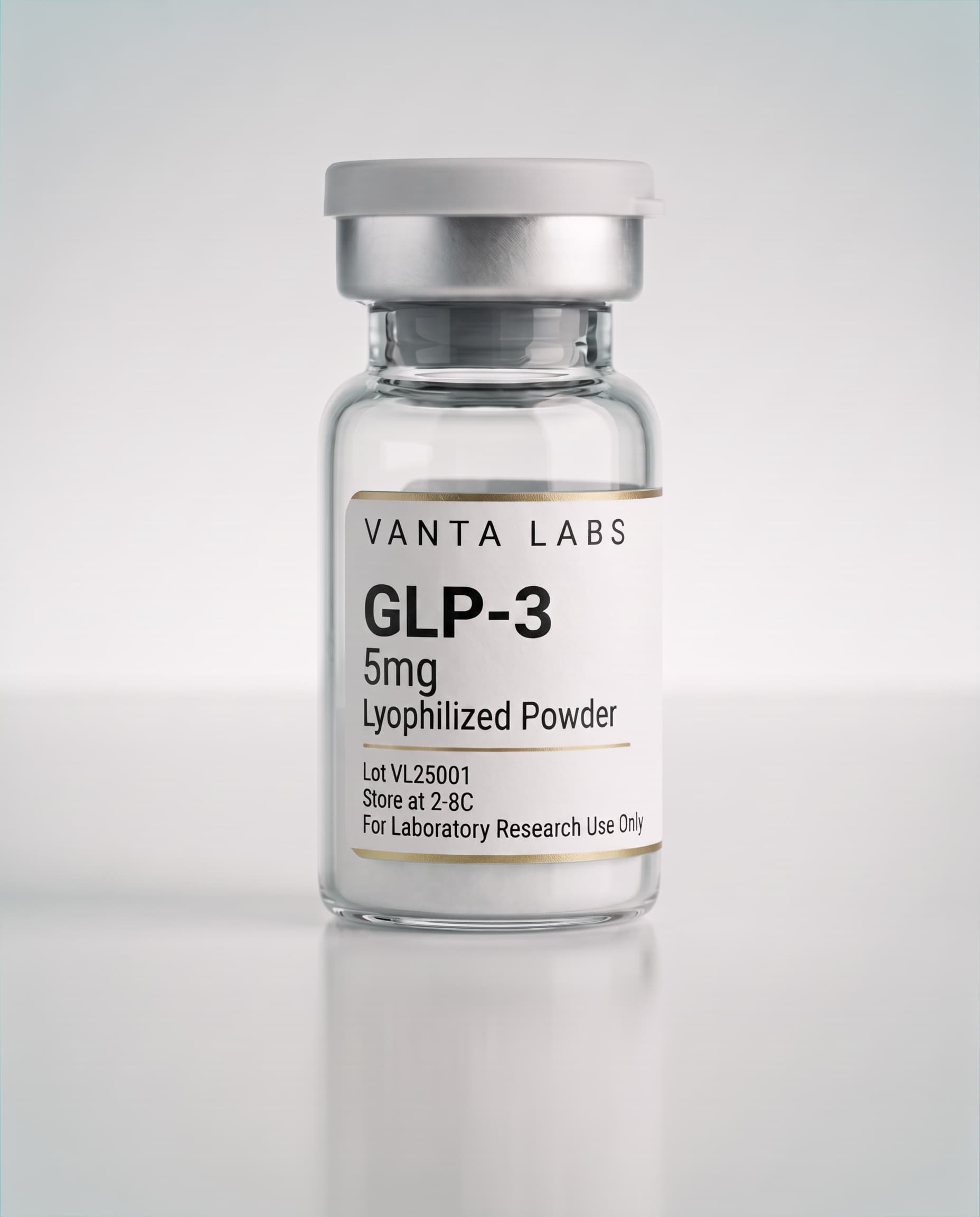
The Vanta Labs product page lists GLP-3 (RT) as a "synthetic triple GIP/GLP-1/glucagon receptor agonist peptide," supplied as a lyophilized powder in 5 mg, 10 mg, 20 mg, and 30 mg vial sizes. "Triple receptor agonist" means the compound is studied for activity at three separate receptor targets rather than one.
What the listing does not currently disclose is just as important. As of this writing, the product page gives no CAS registry number, no molecular formula, no nonproprietary chemical name, and no amino-acid sequence for this specific listing. That gap does not mean the product is unverifiable in every respect; it means those particular identifiers have not been made public, and nothing in this article fills that gap by guesswork.
Understanding the GLP-3 (RT) Name
A product label and a scientific identity are two different things. "GLP-3 (RT)" is how Vanta Labs names this catalog item; it is not a peer-reviewed designation for a receptor, a hormone, or a specific peptide sequence.
This distinction matters because the name echoes "GLP-1," the glucagon-like peptide-1 hormone with a long, independently documented research history. GLP-3 is not a parallel, established third member of that family in the published literature. No peer-reviewed body of work describes a "GLP-3 receptor" the way the GIP, GLP-1, and glucagon receptors are each independently described. Readers should treat "GLP-3" here as this listing's name for a peptide studied against three already-established receptors, not as a new receptor class in its own right.
The absence of a published CAS number, sequence, or molecular formula is a limitation in public identification, not a scientific claim about the compound's effects. Where this article references keyword research that also used the spelling "VLP-3 (RT)," that spelling is treated here only as a keyword variant tied to the same product listing; it is not presented as an alternative product identity.
Triple Receptor Agonism Explained
In receptor pharmacology, an agonist is a molecule that activates a receptor. A "triple agonist" is studied for activity at three distinct receptor targets rather than one. This pattern has drawn substantial research interest because the GIP, GLP-1, and glucagon receptors each sit in related, but not identical, metabolic signaling pathways (Sangwung et al., 2024).
It is important to separate the receptor target from the specific molecule being tested at it. Two different peptides can both be described as "GIP/GLP-1/glucagon triple agonists" while remaining chemically distinct from each other, the same way two different drugs can both be "beta blockers" without being the same compound. A shared receptor-activity description is a starting point for comparison, not proof of identity.
Understanding the Three Receptor Pathways
GIP Receptor
The glucose-dependent insulinotropic polypeptide (GIP) receptor is a class B1 G-protein-coupled receptor (GPCR) activated by the GIP hormone. It is one of the two classically recognized incretin receptors and has been studied for decades as part of normal digestive and endocrine signaling (Sangwung et al., 2024; Sloop et al., 2018).
GLP-1 Receptor
The glucagon-like peptide-1 (GLP-1) receptor is a separate class B1 GPCR, activated by the GLP-1 hormone. It is the most extensively studied of the three receptors discussed here and has an independent, decades-long research record distinct from the GLP-3 (RT) product listing (Sloop et al., 2018).
Glucagon Receptor
The glucagon receptor (GCGR) is also a class B1 GPCR, activated by glucagon rather than by GIP or GLP-1. It belongs to the same receptor subfamily as the GIP and GLP-1 receptors but responds to a structurally distinct ligand and participates in different signaling pathways (Sangwung et al., 2024).
All three receptors share a structural family, but each is independently defined, independently studied, and independently named in the literature, separate from any product that happens to be studied against all three at once.
Retatrutide and Published Triple-Agonist Research
Retatrutide, also designated LY3437943, is a peptide studied in peer-reviewed clinical and structural research for activity at the GIP, GLP-1, and glucagon receptors (Jastreboff et al., 2023; Li et al., 2024). Its clinical research record and its structural characterization are both independently published and documented under that specific name and designation.
Sharing a "triple GIP/GLP-1/glucagon agonist" description with retatrutide does not establish that the Vanta Labs GLP-3 (RT) listing is retatrutide, or that it contains the LY3437943 molecule. The Vanta Labs listing does not publish a sequence, molecular formula, or CAS number that could be compared against retatrutide's published identifiers. Until such a comparison is independently possible, the two should be discussed as separate: one as an independently published, named research compound, and the other as a product listing whose chemical identity remains undisclosed.
Product Identification and Published Specifications
The table below reflects only what the live Vanta Labs product page discloses as of this writing. Entries marked "not published" are not estimates; they are gaps in current public disclosure.
| Attribute | Disclosed information |
|---|---|
| Product name | GLP-3 (RT) Research Peptide |
| Brand / seller | Vanta Labs, operated by Vanta Innovation LLC |
| Disclosed classification | Synthetic peptide studied for agonist activity at the GIP, GLP-1, and glucagon receptors |
| Supplied form | Lyophilized powder |
| Listed vial sizes | 5 mg, 10 mg, 20 mg, 30 mg |
| CAS registry number | Not published |
| Molecular formula | Not published |
| Nonproprietary chemical name | Not published |
| Amino-acid sequence | Not published |
Understanding Analytical Methods in Peptide Research
RP-HPLC Analysis
Reversed-phase high-performance liquid chromatography (RP-HPLC) separates the components of a sample based on how they interact with a hydrophobic column, typically a C18 stationary phase, as the mobile phase composition changes. A detector, often set to 214 nm, records a chromatogram, and the area under the main peak relative to the whole trace is used to calculate a purity percentage (Lian et al., 2021; McCarthy et al., 2023).
LC-MS Analysis
Liquid chromatography-mass spectrometry (LC-MS) combines chromatographic separation with mass measurement. The mass spectrometer reports the molecular weight of separated components, which supports identity assessment by comparing the observed mass against an expected value (Lian et al., 2021).
RP-HPLC vs. LC-MS
These two methods answer different questions, and neither substitutes for the other.
| Method | Question it answers | What it does not establish |
|---|---|---|
| RP-HPLC | How pure is the sample, relative to itself | Does not confirm molecular identity |
| LC-MS | What does the measured mass indicate about identity | Does not, on its own, quantify purity the way RP-HPLC does |
Used together, RP-HPLC and LC-MS give a more complete analytical picture than either method alone. Neither method, individually or combined, establishes sterility, endotoxin status, or suitability for human or veterinary use (McCarthy et al., 2023).
Understanding Batch Documentation and Certificates of Analysis
A Certificate of Analysis (COA) documents the testing performed on one specific batch of material. As of this writing, the Vanta Labs GLP-3 (RT) listing shows batch Vanta184290, tested by Kovera Labs and certified 08/24/2026, using RP-HPLC on a C18 column with UV detection at 214 nm for purity, alongside LC-MS for identity. The reported purity results were 99.512% (5 mg, report KVR-2026-9D098C), 99.778% (10 mg, report KVR-2026-DEAE76), 99.556% (20 mg, report KVR-2026-D6A2FA), and 99.753% (30 mg, report KVR-2026-2B2E1C). Each report can be verified directly by its report number and access code at koveralabs.com/verify, or found through the COA Library. See How to Read a COA for a walkthrough of what a report should show.
These figures describe that batch only. A COA does not apply to a future batch, a different vial size outside the one it was issued for, or a reformulated product. Readers evaluating documentation should always match the batch number printed on a vial against the batch number printed on its COA, rather than assuming any COA on file applies broadly. Vanta Labs states that each vial size carries its own COA, accessible through the product page or the COA Library.
Purity, as reported by RP-HPLC, is also a different measurement from net peptide content. A high purity percentage describes the relative cleanliness of the sample; it does not by itself state how much actual peptide mass is present in a given vial once moisture, counter-ions, and other non-peptide material are accounted for (McCarthy et al., 2023).
Common Terminology Questions, Clarified
1. Is GLP-3 an established receptor or hormone? No. The GIP, GLP-1, and glucagon receptors are each independently established in peer-reviewed literature. No comparable "GLP-3 receptor" or "GLP-3 hormone" is documented in that literature (Sangwung et al., 2024).
2. What does the GLP-3 (RT) product name actually identify? It identifies a Vanta Labs catalog listing for a peptide the page describes as studied for triple receptor agonist activity. It does not identify a specific, independently verified chemical compound, since no sequence, formula, or CAS number is published.
3. What is the scientific meaning of triple receptor agonism? It means a single molecule is studied for activity at three distinct receptor targets. The term describes a pattern of receptor engagement, not a specific compound, and multiple chemically different molecules can each be described this way (Sloop et al., 2018).
4. How are "GIP" and "GIP receptor" terminology different? GIP is the hormone (glucose-dependent insulinotropic polypeptide). The GIP receptor is the distinct protein the hormone binds to activate downstream signaling. A compound described as a "GIP receptor agonist" acts on the receptor, not necessarily as a copy of the native hormone.
5. How does GLP-1 receptor terminology differ from the GLP-3 product label? The GLP-1 receptor is an independently established, extensively studied target, named for the GLP-1 hormone. "GLP-3" is this product's catalog name and is not a parallel, peer-reviewed receptor designation.
6. What does glucagon receptor agonism mean in molecular research? It refers to activity at the glucagon receptor (GCGR), a class B1 GPCR distinct from the GIP and GLP-1 receptors, activated under native conditions by the hormone glucagon (Sangwung et al., 2024).
7. Is the Vanta Labs GLP-3 (RT) listing the same compound as retatrutide (LY3437943)? This cannot currently be confirmed. Retatrutide is independently published under its own name and designation (Jastreboff et al., 2023; Li et al., 2024). The Vanta Labs listing does not disclose identifiers that would allow a direct comparison, so the two should be treated as separate.
8. Why do CAS number, molecular formula, and sequence information matter for chemical identification? These identifiers let independent parties confirm that two materials described similarly are, in fact, the same substance. Without them, a shared description (such as "triple agonist") is not sufficient to establish chemical identity between two listings.
9. What does a "lyophilized powder" specification actually disclose? It describes the physical form the material is supplied in (freeze-dried solid), not its purity, identity, or concentration once reconstituted. Those are separate pieces of information found on the batch's COA.
10. Why should each vial size be matched with its own batch documentation? Analytical results, including purity, are specific to the batch tested. A result for one vial size or one lot does not apply to a different size or a future production run, even of the same labeled product (McCarthy et al., 2023).
11. What is the analytical difference between RP-HPLC and LC-MS? RP-HPLC estimates purity by chromatographic separation; LC-MS supports identity assessment by mass measurement. They answer different questions and are typically used together, not interchangeably (Lian et al., 2021).
12. What can a Certificate of Analysis establish, and what remains outside its scope? A COA can document the testing method, batch number, test date, and the purity and identity findings obtained for that specific batch. It cannot, on its own, establish sterility, endotoxin status, or suitability for any use outside controlled laboratory research.
Research Use Only and Documentation Limitations
GLP-3 (RT), as listed by Vanta Labs, is intended strictly for laboratory research use. It is not intended for human consumption, veterinary use, or for the diagnosis, treatment, cure, or prevention of any condition. No information in this article should be read as medical, clinical, or personal-use guidance of any kind. Researchers should rely on batch-matched documentation, confirm analytical methods directly with the testing laboratory where needed, and treat any undisclosed identifier as undisclosed rather than assumed.
Frequently asked questions
What is GLP-3 (RT)?
GLP-3 (RT) is the product name Vanta Labs uses for a synthetic peptide the listing describes as studied for agonist activity at the GIP, GLP-1, and glucagon receptors. It is supplied as a lyophilized powder for laboratory research use only.
What does GLP-3 (RT) stand for?
Vanta Labs does not publish an expansion of the name on the product page. "RT" marks the research-use-only designation used across the Vanta Labs catalog. The "GLP-3" portion is the catalog label, not a scientific designation for an established hormone or receptor.
Is GLP-3 a recognized receptor?
No. There is no peer-reviewed literature establishing a "GLP-3 receptor" as a distinct, recognized signaling target. The established receptors relevant to this listing's disclosed classification are the GIP receptor, the GLP-1 receptor, and the glucagon receptor, each independently characterized in the scientific literature.
What are triple receptor agonist peptides?
A triple receptor agonist is a molecule studied for activity at three separate receptor targets rather than one. In this context, that means activity described at the GIP, GLP-1, and glucagon receptors. The term describes a pattern of receptor activity, not a single compound or brand.
Which receptors are studied in GLP-3 (RT) research?
The Vanta Labs listing describes GLP-3 (RT) as studied for agonist activity at the GIP receptor, the GLP-1 receptor, and the glucagon receptor. Each of these receptors has its own independent body of published research outside of this specific listing.
Is GLP-3 (RT) the same as retatrutide?
Not according to currently available, verifiable information. Retatrutide (LY3437943) is a separately published compound studied in peer-reviewed clinical and structural research. The Vanta Labs listing does not disclose a chemical identity that confirms it is retatrutide, so the two should be discussed as distinct until independently verified.
Does Vanta Labs publish a CAS number for GLP-3 (RT)?
No. As of this writing, the live product page does not list a CAS registry number, molecular formula, nonproprietary chemical name, or amino-acid sequence for this listing.
What form is GLP-3 (RT) supplied in?
The listing describes GLP-3 (RT) as supplied in lyophilized powder form.
Which vial sizes are listed for GLP-3 (RT)?
The product page lists 5 mg, 10 mg, 20 mg, and 30 mg vial sizes.
Does each vial size have a separate COA?
Vanta Labs states that each vial size has its own Certificate of Analysis, accessible through the product page or the COA Library. A COA is specific to the batch and vial size it was issued for and does not apply to other batches.
What is the difference between RP-HPLC and LC-MS testing?
RP-HPLC (reversed-phase high-performance liquid chromatography) separates a sample's components to estimate chromatographic purity. LC-MS (liquid chromatography-mass spectrometry) measures molecular mass to support identity assessment. The two methods answer different questions, and neither alone confirms sterility or suitability for human or veterinary use.
What does a peptide Certificate of Analysis report show?
A COA typically reports the testing laboratory, batch number, test date, analytical methods used (such as RP-HPLC and LC-MS), and the resulting purity and identity findings for that specific batch. It does not establish anything about a different batch or vial size.
Related products
Sources
- Vanta Labs, GLP-3 (RT) product listing
- Jastreboff AM, et al. "Triple-Hormone-Receptor Agonist Retatrutide for Obesity." N Engl J Med. 2023.
- Li C, et al. "Structural basis of GIPR, GLP-1R, and GCGR activation by the triple agonist retatrutide." Cell Discovery. 2024.
- Sangwung P, Ho JD, Siddall T, Lin J, Tomas A, Jones B, Sloop KW. "Class B1 GPCRs: Insights into Multi-Receptor Pharmacology for the Treatment of Metabolic Disease." Am J Physiol Endocrinol Metab. 2024;327(5):E600-E615.
- Sloop KW, Briere DA, Emmerson PJ, Willard FS. "Beyond Glucagon-like Peptide-1: Is G-Protein Coupled Receptor Polypharmacology the Path Forward to Treating Metabolic Diseases?" ACS Pharmacol Transl Sci. 2018;1(1):3-11.
- Lian Z, Wang N, Tian Y, Huang L. "Characterization of Synthetic Peptide Therapeutics Using Liquid Chromatography-Mass Spectrometry: Challenges, Solutions, Pitfalls, and Future Perspectives." J Am Soc Mass Spectrom. 2021;32(8):1852-1860.
- McCarthy D, Han Y, Carrick K, Schmidt D, Workman W, Matejtschuk P, Duru C, Atouf F. "Reference Standards to Support Quality of Synthetic Peptide Therapeutics." Pharm Res. 2023;40(6):1317-1328.