What Is GHK-Cu Peptide? Chemical Identity and Testing
By Vanta Labs Research teamPublished 10 min read
GHK-Cu peptide is the copper(II) complex of the tripeptide glycyl-L-histidyl-L-lysine — here's how its molecular identifiers and copper coordination chemistry let you read a specification sheet or COA accurately, without overstating what a purity or identity result actually shows.
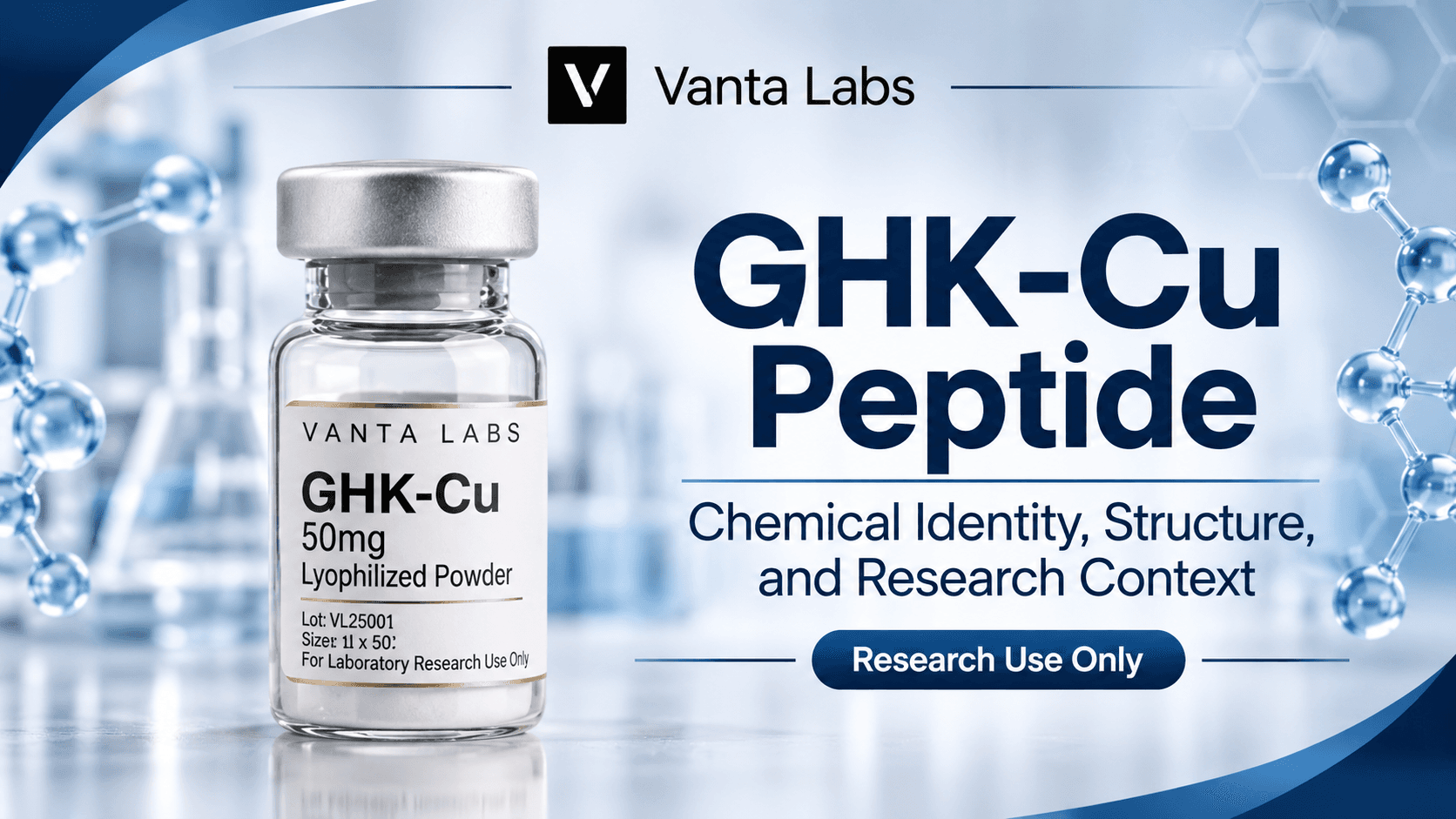
What Is GHK-Cu, Exactly?
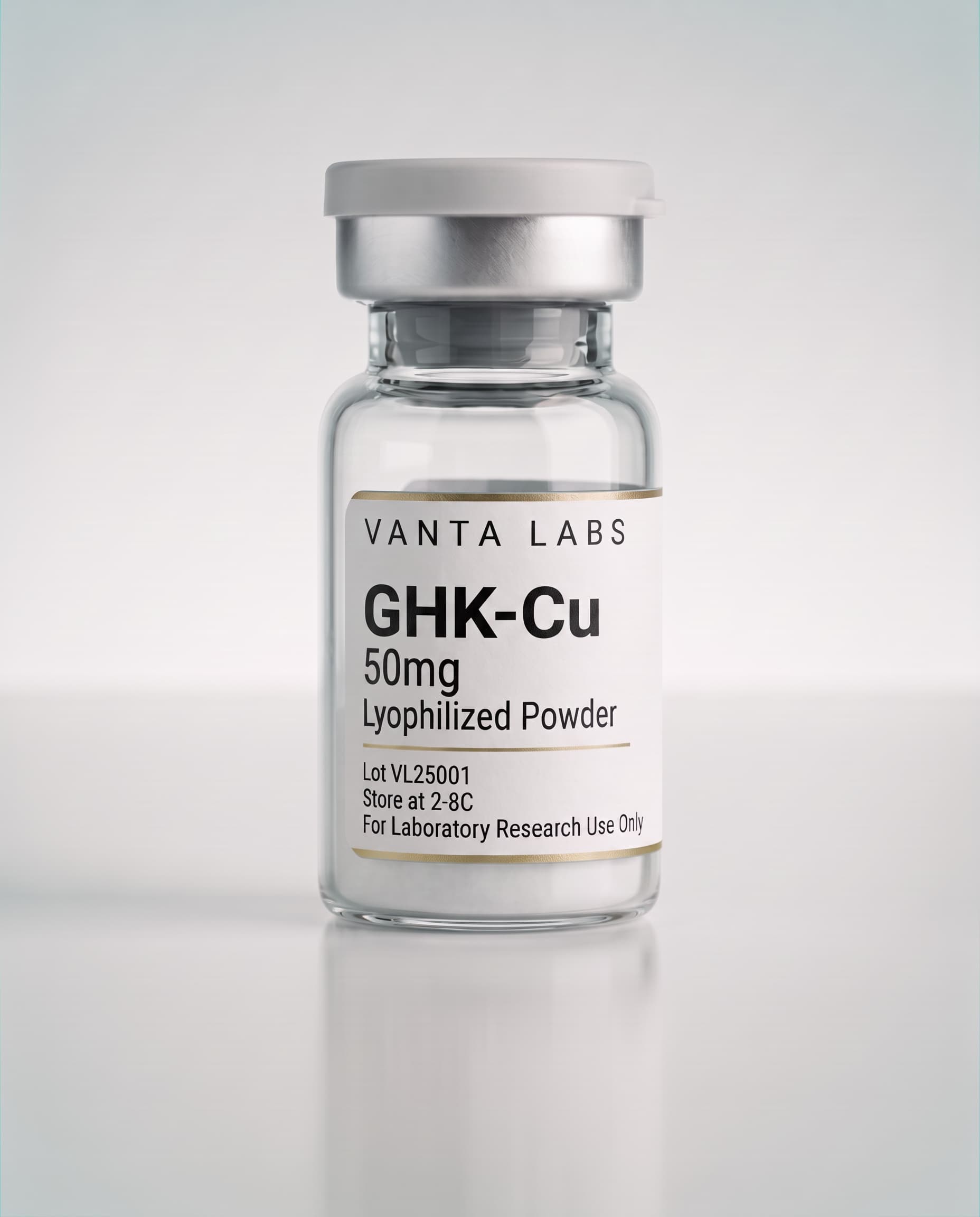
GHK-Cu is the copper(II) complex of a small tripeptide, glycyl-L-histidyl-L-lysine, commonly abbreviated GHK. In plain terms, it is three amino acids (glycine, histidine, and lysine) linked together into a short peptide chain, which then binds a copper ion in a specific coordination geometry. The product sold under this name is the copper-bound form, supplied as a lyophilized (freeze-dried) powder for research applications. It is not a drug, food, cosmetic, or dietary supplement, and it carries no approved human or veterinary use.
What Does the Name "GHK-Cu" Mean?
The naming is more literal than it looks. "G," "H," and "K" are the standard one-letter abbreviations for glycine, histidine, and lysine, read in the order they appear in the peptide chain. "Cu" is simply copper's chemical symbol. Put together, GHK-Cu identifies both the peptide sequence and the fact that it is present as a copper complex, rather than as the free peptide. This two-part naming convention shows up throughout the chemical and supplier literature, including in product documentation and PubChem's record for this compound (CID 71587328).
GHK or GHK-Cu? Resolving the Mix-Up
Here's the mix-up that trips up most product listings: GHK is the bare tripeptide, glycine, histidine, and lysine joined in sequence, with no metal bound. GHK-Cu is what you get once that same tripeptide picks up a copper(II) ion. They're related, but not interchangeable — different molecular formulas, different molecular weights, and a specification sheet, CAS number, or Certificate of Analysis written for one does not apply to the other. That distinction matters most when comparing documentation across suppliers.
GHK-Cu's Molecular Identity: Sequence and Copper-Complex Designation
The peptide backbone of GHK-Cu is the sequence Gly-His-Lys, written formally as glycyl-L-histidyl-L-lysine. What distinguishes GHK-Cu from the free tripeptide is the addition of a copper(II) ion coordinated into that structure. Because the compound is typically represented as a cation in chemical databases, with a molecular formula given as C14H23CuN6O4+, documentation should be read with that charge state in mind rather than assuming a neutral molecule. Vanta Labs' own guide to reading peptide identity data walks through how this kind of notation translates into what actually appears on a product specification sheet.
How Copper Actually Attaches to the Peptide
Copper coordination chemistry in GHK-Cu has been studied directly, and it is worth separating what spectroscopic work has actually shown from looser descriptions that circulate online. According to PubMed, a spectroscopic study of the copper(II) complex of glycyl-L-histidyl-L-lysine in solution used optical, electron paramagnetic resonance, and electron spin-echo methods to examine how copper is bound, and found that at physiological pH the copper sits in a mononuclear 1:1 complex coordinated primarily through nitrogen atoms, with the histidine imidazole ring contributing one of them (Freedman et al., 1982, DOI). The same work noted that this solution-phase arrangement differs from an oxygen-bridged structure previously reported from solid-state crystallographic analysis, meaning the coordination picture can depend on whether the compound is examined in solution or as a solid.
That same study also tracked how the complex changes across a pH range, identifying three distinct optical transitions as pH increased, each tied to the loss of a specific proton from the ligand system. At the lowest of these transitions, the peptide takes up copper to form the species present under physiological conditions, while at higher pH the researchers observed a further structural change in which the copper remained bound to the imidazole nitrogen even as other parts of the coordination environment shifted. For a reader of a specification sheet, the practical point is narrower than any of this detail: coordination chemistry describes the arrangement of atoms around the copper ion under defined laboratory conditions, and it is a different kind of statement from a claim about what the resulting complex does once introduced into a biological system.
Reading the Label: Molecular Formula, Molecular Weight, and CAS Number
Vanta Labs' published specifications list GHK-Cu under CAS number 89030-95-5, with a molecular formula of C14H23CuN6O4+ and a molecular weight of approximately 402.92 g/mol, cross-referenced to PubChem CID 71587328. These values describe the copper(II) complex specifically, represented as a cation with the counter-ion unspecified in the base record. Because related CAS numbers exist for the free GHK tripeptide, for the acetate salt form of the copper complex, and for a handful of deleted or superseded CAS entries that show up in older supplier catalogs, it is worth confirming that any CAS number or molecular weight you are comparing against actually refers to the same ionic form before treating two listings as equivalent. A mismatch here is one of the more common sources of confusion when cross-checking documentation from different suppliers, since a formula that omits the cation's charge, or that reflects an acetate salt rather than the base complex, will carry a slightly different molecular weight even though it describes essentially the same peptide-copper chemistry.
Is GHK-Cu the Same as Copper Tripeptide-1?
Within cosmetic and biochemical nomenclature, "copper tripeptide-1" and "prezatide copper" both appear as synonyms for the GHK-Cu copper complex, alongside the more descriptive "copper(II) complex of glycyl-L-histidyl-L-lysine." These are naming conventions for the same chemical entity rather than separate compounds, though which name a given supplier, database, or regulatory listing uses can vary by context. When cross-checking a product against outside documentation, matching the CAS number and molecular formula is a more reliable way to confirm identity than matching the name alone.
Separating Established Fact From Proposed Mechanism in GHK-Cu Research
GHK-Cu has an unusually large published literature, and not all of it carries the same evidentiary weight. Some statements, such as the peptide's sequence, its copper-binding capability, and its basic coordination chemistry, rest on direct spectroscopic and analytical measurement. Other statements circulating in secondary sources describe proposed biological mechanisms, cell-culture observations, or animal-model findings, which are a different category of evidence with their own limitations around model type, concentration, and species relevance. This article intentionally limits itself to the first category: verifiable chemical identity and analytical characterization. It does not extend into proposed biological mechanisms or outcomes, which fall outside what a Research Use Only product listing should claim.
How to Read GHK-Cu Laboratory Research Without Overreading It
When evaluating any paper or dataset involving GHK-Cu, it helps to ask three questions before drawing a conclusion: what model was used (a buffered solution, an isolated protein, a cell line, an animal model), what concentration or condition was tested, and what was actually measured. A finding generated in a specific in vitro or in vivo model under specific conditions describes that model under those conditions. It does not automatically generalize to other systems, and it is not evidence of a human outcome. Reading research this way is simply accurate research literacy, not a disclaimer tacked onto otherwise promotional claims.
What an HPLC Purity Number Does (and Doesn't) Prove
Reversed-phase HPLC (RP-HPLC) works by passing a dissolved sample through a column packed with material that separates compounds based on how they interact with it, then detecting each separated component as it elutes, commonly by ultraviolet absorbance. Vanta Labs tests this product by RP-HPLC on a C18 column with diode-array detection at 214 nm, establishing a purity figure for each batch (identity is confirmed separately, by LC-MS). That figure is specific to the lot tested, so it is not repeated here; it is published on the current batch's Certificate of Analysis in the COA library. A purity number from RP-HPLC describes the proportion of the detected signal attributed to the target compound's peak relative to other peaks in the same run. It is a statement about chromatographic purity, not a statement about sterility, endotoxin levels, residual solvents, heavy metals, or suitability for any particular use. Vanta Labs' own explainer on purity and third-party testing goes into more detail on what a purity figure does and does not establish.
What LC-MS Adds That HPLC Alone Doesn't
HPLC is good at separation and relative quantification, but a retention time alone cannot definitively confirm what a compound is. Liquid chromatography-mass spectrometry (LC-MS) combines that same separation step with mass measurement, so each separated component is identified by its mass rather than only by when it eluted from the column. According to PubMed, a 2024 methodological review of HPLC-MS in proteomics research describes how combining chromatographic separation with mass spectrometry allows researchers to resolve and identify complex peptide and protein mixtures with a level of specificity that chromatography alone cannot provide (Liu et al., 2024, DOI). Vanta Labs lists LC-MS as its identity-confirmation method for GHK-Cu, run alongside the RP-HPLC purity test, which is why a complete Certificate of Analysis typically reports both an identity result and a separate purity percentage rather than treating the two as interchangeable.
How to Read This Product's Certificate of Analysis
A Certificate of Analysis is only meaningful if it is tied to the specific batch in hand. For this product, that means checking that the batch number on the container matches the batch referenced in the report, confirming the report number and any listed verification or access code against the testing laboratory's own records, and noting the report date, since a COA reflects the sample tested on that date rather than an ongoing guarantee. Vanta Labs' COA library provides access to current batch reports for this and other products, and its guide to reading peptide identity data explains how the chemical identifiers on a report relate to the compound actually being tested. A COA documents what was tested and what was found for that specific batch; it is not, by itself, a certification of safety, sterility, or fitness for any use beyond the laboratory research context for which the material is supplied.
Closing Notes
Strip away the marketing and GHK-Cu is a copper(II) complex of the tripeptide Gly-His-Lys, with established molecular identifiers and a body of coordination-chemistry literature describing exactly how the copper is held in place. Reading a product specification sheet or a Certificate of Analysis accurately comes down to keeping a few distinctions straight: GHK versus GHK-Cu, purity versus identity, and a verified chemical fact versus a proposed mechanism from a specific research model. This material is supplied strictly for laboratory research use. It is not for human or veterinary use, not for human consumption, and not a drug, food, cosmetic, or dietary supplement. For current batch-specific documentation, consult Vanta Labs' COA library directly.
Frequently asked questions
What is GHK-Cu peptide?
GHK-Cu is the copper(II) complex formed between the tripeptide glycyl-L-histidyl-L-lysine (Gly-His-Lys) and a copper ion. It is supplied as a research chemical, not a drug, food, cosmetic, or dietary supplement, and it is intended strictly for laboratory research use.
What does the name "GHK-Cu" actually stand for?
"GHK" abbreviates the three amino acid residues in the peptide's sequence: glycine (G), histidine (H), and lysine (K, the standard one-letter code for lysine). "Cu" is the chemical symbol for copper, added to indicate the peptide's copper(II) complex rather than the free tripeptide.
Is GHK-Cu the same thing as GHK?
No. GHK is the uncomplexed tripeptide on its own. GHK-Cu is what forms once that tripeptide binds a copper(II) ion in a specific coordination arrangement. The two have different molecular formulas and different molecular weights, and documentation for one should not be read as applying to the other.
What is the sequence of GHK-Cu?
The underlying peptide sequence is Gly-His-Lys (glycine, histidine, lysine), written in full as glycyl-L-histidyl-L-lysine. In GHK-Cu, this sequence is bound to a copper(II) ion, which is why the compound is represented as a copper complex rather than as the peptide sequence alone.
How does copper actually bind to the GHK peptide?
According to PubMed, spectroscopic work on the Cu(II) complex of glycyl-L-histidyl-L-lysine found that, in solution at physiological pH, copper is coordinated by nitrogen atoms rather than through a crystallographic oxygen-bridged arrangement seen in the solid state, with the histidine imidazole ring supplying one of the coordinating nitrogens (Freedman et al., 1982). This is a description of coordination chemistry, not a statement about any biological effect.
Is GHK-Cu the same as copper tripeptide-1?
Copper tripeptide-1 is a synonym used for the same copper(II) complex in certain industry and database nomenclature, alongside other synonyms such as prezatide copper. These are different names for the same chemical entity rather than different compounds, though the terminology a given supplier or database uses can vary.
What is the molecular weight of GHK-Cu?
As listed in product documentation and PubChem (CID 71587328), the copper(II) complex form carries a molecular weight of approximately 402.92 g/mol, with a molecular formula given as C14H23CuN6O4+. This figure applies to the copper complex specifically, not to the free GHK tripeptide, which has its own separate molecular weight.
What's the difference between the HPLC purity figure and the LC-MS result on a Certificate of Analysis?
HPLC (high-performance liquid chromatography) separates the components of a sample and estimates what fraction of the total corresponds to the target peak, producing a purity percentage. LC-MS (liquid chromatography-mass spectrometry) adds mass measurement to that separation, confirming the identity of the compound by its mass rather than only its retention time. A sample can report high purity by HPLC while identity still needs the mass data from LC-MS to be confirmed with the same confidence.
Does a high HPLC purity number mean the product is safe or sterile?
No. A purity percentage from RP-HPLC describes the proportion of the sample matching the target compound's chromatographic peak. It does not test for sterility, endotoxin levels, residual solvents, or heavy metals, and it is not a statement about safety for any use. Those are separate tests that must be run and reported independently if they are relevant to a given research protocol.
What does "Research Use Only" mean for a compound like GHK-Cu?
Research Use Only means the material is supplied strictly for laboratory research and is not for human or veterinary use, human consumption, or any diagnostic, therapeutic, or cosmetic application. It is not a drug, food, cosmetic, or dietary supplement, and no dosing, administration, or treatment guidance applies to it.
Related products
Sources
- Freedman JH, Pickart L, Weinstein B, Mims WB, Peisach J. "Structure of the Glycyl-L-histidyl-L-lysine-copper(II) complex in solution." Biochemistry. 1982;21(19):4540-4544.
- Liu W, Weng LX, Gao MX, Zhang XM. "Applications of high performance liquid chromatography-mass spectrometry in proteomics." Se Pu (Chinese Journal of Chromatography). 2024;42(7):601-612.
- PubChem Compound Summary for CID 71587328
- Vanta Labs. GHK-Cu product page and batch documentation
- Vanta Labs. "Reading Peptide Identity Data"
- Vanta Labs. "Purity & Third-Party Testing, Explained"
- Vanta Labs. "What 'Research Use Only' Actually Means"