How to Verify a Peptide Lab's Testing Is Real, Step by Step
By Vanta Labs Research teamPublished 12 min read
How to verify a peptide lab's testing is real: confirm the laboratory's identity, authenticate the report number directly with the lab, match the batch and sample details, and check that HPLC and LC-MS results actually say what they're assumed to say.
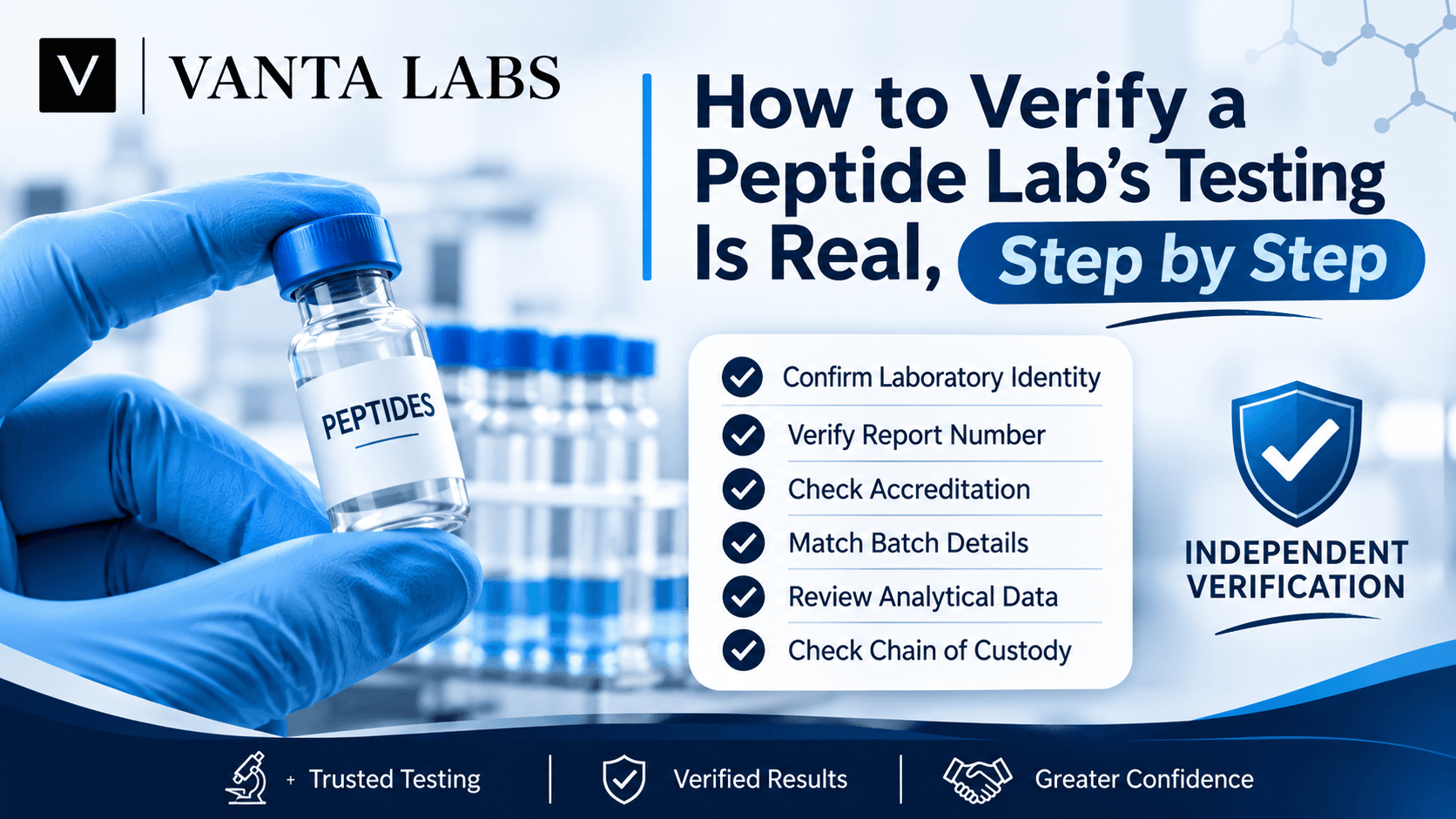
# How to Verify a Peptide Lab's Testing Is Real, Step by Step
A Certificate of Analysis can show a laboratory name, a report number, a purity percentage, and an analytical method, all on one page, and still leave the central question open: did the named laboratory actually produce this document, for this exact batch, using the method it claims. Seeing those details on a PDF is not the same as confirming them. Independent verification means checking four separate things: whether the laboratory is identifiable, whether it actually issued the report, whether the report corresponds to the specific sample and batch in question, and whether the analytical evidence genuinely supports what the report states. This guide walks through each of those checks in order, with the limitations of common analytical methods explained along the way, so that reading a peptide lab report becomes a process rather than a guess.
How to Identify the Laboratory Named on a COA
A name or logo printed on a report establishes nothing by itself. The first step is confirming that the laboratory is a real, identifiable entity rather than a label.
Start by finding the laboratory's full legal name and its official website independently, meaning through a general search rather than a link supplied on the COA itself. Check that the laboratory's published contact information, physical address, and stated testing location are consistent across its own site and any third-party listings. Distinguish a testing laboratory, which performs the analysis itself, from a distributor, broker, or intermediary that commissions testing elsewhere and republishes the result. Suppliers sometimes name a laboratory without clarifying that relationship.
A practical approach: search the laboratory's name alongside terms like "accreditation," "address," or "contact," and compare what independent sources return against what the supplier's documentation claims. If a laboratory has no independently discoverable presence beyond the document in question, that is a reason to ask further questions rather than to proceed.
How to Verify a COA Report Number Directly With the Laboratory
Many Certificates of Analysis include a report number or reference ID. That number is only useful if the issuing laboratory itself can confirm it.
Look for an official laboratory verification portal, separate from the supplier's own website. Some laboratories provide an online lookup where a report number and an access code return the original record. Where no portal exists, contact the laboratory directly using contact information sourced independently, not copied from the supplier's PDF, and ask the laboratory to confirm whether that specific report number corresponds to a document it issued. If online verification is unavailable, ask what the laboratory can provide instead, such as a reissued copy or written confirmation.
Vanta Labs' own Testing and Quality page is one example of how a site can structure this kind of access, describing the labs that issue its reports and pointing to each laboratory's own verification method rather than asking buyers to rely on the supplier's copy alone. A supplier displaying a laboratory's logo is not equivalent to that laboratory confirming the report, so the confirmation step matters even when a name looks familiar.
How to Check ISO/IEC 17025 Accreditation and Its Exact Scope
Accreditation claims are commonly used as a shorthand for trustworthiness, but the claim itself needs verification.
ISO/IEC 17025 is the international standard for the competence of testing and calibration laboratories. ISO does not accredit laboratories directly: that role belongs to accreditation bodies, which are themselves overseen by the International Laboratory Accreditation Cooperation (ILAC) through its mutual recognition arrangement. To check a claim, identify the specific accreditation body named (not just "ISO 17025 accredited" with no body attached), search that body's official public directory, and confirm the laboratory's legal name, accredited testing location, and current status. ILAC's own signatory search lists which accreditation bodies are currently recognized under that arrangement, and NIST explains the distinction between an accreditation claim and a certification claim directly.
The detail most often skipped is scope. Accreditation under ISO/IEC 17025 applies to specific methods at a specific location, listed in the laboratory's scope of accreditation, not to every test the laboratory might offer. A laboratory can hold valid accreditation for one method while running a different, unaccredited method for another test on the same sample. Confirm that the exact method relevant to the report, such as a specific HPLC or LC-MS procedure, appears in the current scope before treating accreditation as support for that particular result.
How to Match the Compound, Sample Description and Batch Number
A report can be entirely genuine and still describe a different batch than the one in hand.
Compare the compound or sample name, the batch or lot number, the sample description, the labeled quantity where relevant, and the sample receipt, testing, and report issue dates. Every one of these should match the physical product being evaluated, not just the product name on the label.
| Verification detail | What the COA states | What to compare it against |
|---|---|---|
| Compound name | As written on the report | Product label and listing |
| Batch or lot number | As written on the report | Vial, box, or package marking |
| Sample description | Form, size, or concentration described | Physical product in hand |
| Labeled quantity | Stated where reported | Vial or container label |
| Dates | Receipt, testing, issue | Internal consistency and plausibility |
A report issued for one batch does not extend to a different batch, even for the identical product, because each production run can differ in ways a shared product name does not reveal.
What HPLC Testing Actually Shows
A high purity percentage is one of the most visible numbers on a COA, and one of the most frequently misread.
High-performance liquid chromatography separates a sample's components as they pass through a column at different rates, producing a chromatogram where each component appears as a peak at a particular retention time. The area under each peak, expressed as a percentage of the total area, is typically reported as the purity figure. That number depends on the specific method, column, and detection settings used, which is why the stated method matters as much as the percentage itself.
Critically, an HPLC purity percentage describes chromatographic composition under that method. It does not, by itself, establish molecular identity, total content by mass, or any other quality attribute. A sample can show a high purity percentage by one method while an identity question remains entirely unaddressed.
What LC-MS and Mass Spectrometry Can Actually Confirm
A mass result on a COA is often read as confirming everything about a sample, which overstates what the method does.
Liquid chromatography mass spectrometry (LC-MS) pairs chromatographic separation with mass analysis, allowing a laboratory to compare a sample's observed molecular mass against the expected mass for the claimed compound. A close match between observed and expected mass is identity-supporting evidence: it indicates the detected molecule is consistent with the expected one.
What it does not do, on its own, is establish full sequence confirmation, complete structural characterization, chromatographic purity, or net content. Identity evidence and purity evidence answer different questions, and a mass match alone should not be read as resolving both at once.
How to Examine Chromatograms, Spectra and Supporting Data
A report that states only a final percentage or a one-line conclusion, with no visible analytical evidence behind it, is harder to evaluate than one that shows its work.
Look for the actual chromatogram, the peak table showing retention times and integration values, the relevant mass spectrum where identity testing was performed, the observed and expected mass, the stated analytical method, the units used for each result, and reviewer or authorization details on the document. These elements let a reader (or a second laboratory, in an independent retest) see how a reported number was actually derived.
A summarized result and the supporting analytical data behind it are not the same thing. Not every legitimate laboratory formats its reports identically, so the absence of one specific element is not automatic proof of a problem, but a report with no visible supporting data at all is harder to independently assess than one that includes it.
How to Investigate Sample Collection and Chain of Custody
Even a laboratory report that is entirely genuine answers a narrower question than most readers assume.
A laboratory confirms findings for the specific sample it received and tested. Whether that sample accurately represents the vial or batch under evaluation depends on how it was collected, who submitted it, whether it was sealed, how it was transported, and how its receipt was documented at the laboratory. This is the chain of custody, and it is a separate question from whether the report itself is authentic.
The distinction worth holding onto: a genuine laboratory report establishes what the laboratory found in the sample it analyzed. It does not, by itself, establish that the sample came from the exact vial or production run being evaluated, unless there is documentation connecting the two.
Understand Purity, Identity, Assay and Net Content
These four terms describe different measurements and are often used as if they were interchangeable.
| Measurement | What it addresses | What it does not automatically establish |
|---|---|---|
| Purity | Chromatographic composition under a stated method | Molecular identity or total mass |
| Identity | Evidence supporting the proposed compound | Overall purity or net content |
| Assay | Quantitative measurement under a specified procedure | Every other quality attribute |
| Net content | Measured amount of material under the stated procedure | Chromatographic purity |
The method, reference standard, sample preparation, and calculation procedure behind each figure all affect the result. There is no single universal method that answers every analytical question about a sample at once, which is why a report should be read for the specific attributes it actually measured.
How to Check Whether Other Testing Claims Are Actually Documented
Marketing language sometimes describes testing more broadly than the available documentation supports.
Sterility testing, endotoxin testing, heavy metals testing, residual solvent testing, water content testing, microbiological testing, identity testing, purity testing, and assay or content testing are separate analytical attributes, each requiring its own method or panel. A COA that covers purity and identity says nothing about sterility or heavy metals unless those results appear on the same document or a related one.
A test should never be assumed to have been performed, let alone passed, unless the actual documentation supports it. If a product description references testing that the available COA does not show, that is a prompt to ask for the specific report covering that attribute rather than to assume it exists.
How to Identify COA Red Flags Without Making Unsupported Accusations
Inconsistencies in documentation are common enough that it helps to have a checklist for interpreting them fairly.
Watch for: a laboratory identity that cannot be independently confirmed, a report number the issuing laboratory cannot authenticate, a batch number that does not match the physical product, an inconsistent compound or sample description, testing and report dates that do not line up, a missing or unclear analytical method, results reported without units, no supporting data behind a stated conclusion, an accreditation claim that cannot be located in the relevant official register, and report details that differ from what the laboratory itself confirms.
Any one of these points to a need for clarification, not an automatic conclusion of fraud. A missing document, a failed initial lookup, or an unanswered inquiry means the claim is currently unverified or not independently confirmed, which is a different statement than calling it fake. Use language that matches what has actually been established: unverified, not independently confirmed, inconsistent documentation, or insufficient supporting evidence, rather than language that asserts fraud without the evidence to support it.
What a Verified COA Cannot Prove
Even a report that passes every check above still has defined limits.
A COA relates to the specific sample the laboratory received, not automatically to every vial in a batch. A report for one batch does not apply to a different batch of the same product. HPLC purity does not independently establish molecular identity, and an identity result does not independently establish purity or net content. A purity result does not establish sterility or endotoxin status, which require their own separate testing. Accreditation does not guarantee any individual result; it indicates assessed competence for the method, not a guarantee on every test run under it. A verified report, on its own, does not establish suitability, safety, or effectiveness for human or veterinary use.
Report authentication, method review, batch matching, and sample traceability work together. None of them substitutes for the others, and treating any single one as sufficient on its own is where most verification mistakes happen.
Peptide Laboratory Testing Verification Checklist
- Identify the laboratory's full legal name and confirm it independently of the COA.
- Find the laboratory's official website through a separate search, not a link on the report.
- Authenticate the COA report number directly with the issuing laboratory, through a portal or direct contact.
- Check any accreditation claim against the relevant official accreditor's register.
- Review the specific scope of that accreditation for the method in question.
- Match the exact compound name and sample description to the physical product.
- Match the batch or lot number between the report and the product.
- Examine the HPLC documentation, including the chromatogram and method, not just the percentage.
- Review LC-MS or other identity evidence where it is available and relevant.
- Check that receipt, testing, and report issue dates are internally consistent.
- Ask about sample collection and chain of custody between the production batch and the laboratory.
- Confirm which specific testing attributes are actually documented, rather than assuming broader coverage.
Frequently asked questions
How do you verify that a peptide lab actually performed a test?
Confirm the report number directly with the issuing laboratory, ideally through its own verification portal or by contacting it using independently sourced details rather than the contact information printed on the report. Independently confirm the laboratory's legal identity and official website first. A report you cannot authenticate with the lab itself should be treated as unverified rather than accepted on its face.
How can I verify a peptide certificate of analysis?
Match the compound name, batch or lot number, and sample description against the physical label, confirm the report number with the issuing laboratory, review the stated analytical method and supporting data, and check any accreditation claim in the accreditor's official register. Treat any step you cannot complete as an open question rather than skipping it.
Does HPLC prove peptide identity?
No. High-performance liquid chromatography characterizes chromatographic behavior, typically reported as a purity percentage, under a specific stated method. Identity is a separate question that generally requires an orthogonal technique, such as mass spectrometry, alongside HPLC. A high purity figure on its own says nothing about whether the correct compound is present.
Does LC-MS prove peptide purity?
Not on its own. Liquid chromatography mass spectrometry can support identity characterization by comparing observed and expected molecular mass, but it is not automatically a substitute for a validated purity method. A mass match confirms a result consistent with the expected mass, not the overall percentage purity of the sample.
What does ISO/IEC 17025 accreditation mean for a peptide testing laboratory?
It indicates that an accreditation body has assessed the laboratory's technical competence for specific, defined methods, known as its scope of accreditation. ISO itself does not accredit laboratories. Confirm the actual accreditation body, the laboratory's legal name and testing site, current status, and whether the specific method in question is listed in that scope before relying on the claim.
Can an accredited laboratory perform tests outside its accredited scope?
Yes. Accreditation applies only to the methods and testing locations listed in that laboratory's current scope, not to every test the laboratory might offer. A lab can be accredited for one method and run another, unaccredited one, so the specific method relevant to the report needs to be checked against the scope directly.
Does a COA for one batch apply to every batch?
No. A Certificate of Analysis describes the specific sample tested under a specific batch or lot number on a specific date. It does not extend to other batches of the same product, even if the product name and specifications are otherwise identical. Each batch needs its own matching, dated report to be considered covered.
What should I do if a laboratory cannot confirm a report number?
Treat the report as unverified rather than assuming the material is defective or the laboratory is fictitious. Ask what alternative confirmation the laboratory can provide, such as a written statement or a reissued copy, and note the gap when deciding whether to rely on the document. A failed first attempt at confirmation is not, by itself, proof of fraud.
Does a verified COA prove what is inside my exact vial?
Not necessarily. A verified report confirms the laboratory's findings on the sample it received and analyzed. Whether that sample accurately represents your exact vial depends on how the sample was collected, sealed, and tracked from the production batch to the laboratory, which is a separate question from whether the report itself is genuine.
Are purity, identity, content, sterility and endotoxin the same tests?
No. Each is a distinct analytical attribute that requires its own method or test panel. Purity describes chromatographic composition, identity confirms the compound matches what is claimed, net content measures the amount present, and sterility and endotoxin testing are separate microbiological and pyrogen checks. A report only supports the attributes it actually includes.
What information should a peptide laboratory report contain?
Look for an identifiable laboratory name, a report or certificate number, a clear sample and batch description, the dates of receipt, testing, and issue, the analytical method used, the results with appropriate units, and reviewer or authorization details. Not every legitimate laboratory uses an identical layout, so absence of one detail is a prompt to ask, not an automatic red flag.
Can a supplier-issued certificate count as independent third-party testing?
Only if the testing laboratory and its independence from the supplier can be established separately from the supplier's own claim. A document a supplier produces or formats itself is not independent third-party evidence merely because it references a laboratory name. Confirming the relationship between the supplier and the named laboratory is part of verifying the report.
Sources
- European Medicines Agency. Guideline on the Development and Manufacture of Synthetic Peptides.
- International Laboratory Accreditation Cooperation (ILAC). Signatory Search.
- International Laboratory Accreditation Cooperation (ILAC). ILAC MRA and Signatories.
- NIST National Voluntary Laboratory Accreditation Program. Accreditation vs. Certification.