GLOW Peptide Blend: Composition and Component Research
By Vanta Labs Research teamPublished 10 min read
A breakdown of what the Vanta Labs GLOW peptide blend actually contains, how its three labelled components are identified in the scientific literature, and what the batch certificate of analysis does and does not establish.
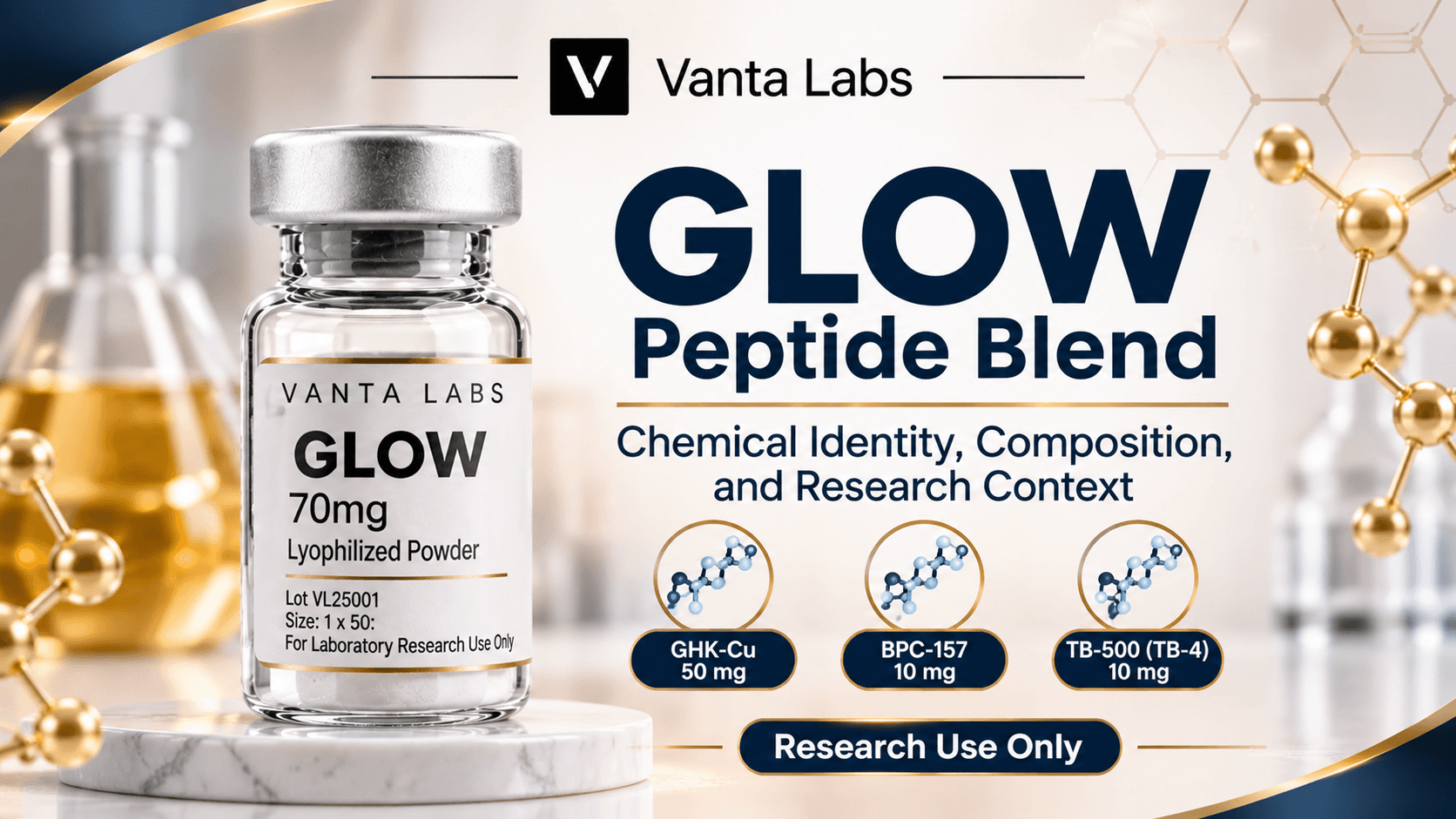
GLOW is a labelled research product from Vanta Labs combining three separately identified peptide components, GHK-Cu, BPC-157, and TB-500 (TB-4), in a single 70 mg vial. It is not one peptide molecule. This guide explains what the label actually specifies, how each component is identified in the independent literature, what the batch certificate of analysis documents, and where the evidence stops. For laboratory research use only.
1. What the GLOW Blend Actually Is
A name like "GLOW" reads as though it describes a single substance, and that assumption is the first thing worth correcting. According to the current Vanta Labs product listing, GLOW is a mixture: three peptide components, each with its own established (or in one case, disputed) chemical identity, combined into one vial and sold under a single product name. The name identifies a formulation, not a molecule. That distinction matters for every section that follows, because chemical identity, purity, and research history all apply at the level of the individual components, not at the level of the blend as a whole.
2. What Is Exactly Inside the 70 mg
The product label specifies three components and their individual labelled amounts:
| Component | Labelled Amount |
|---|---|
| GHK-Cu | 50 mg |
| BPC-157 | 10 mg |
| TB-500 (TB-4) | 10 mg |
| Total | 70 mg |
Supplied form: lyophilized (freeze-dried) powder, one vial. This table reflects the current listing at vantalabsresearch.com/products/glow; readers comparing other sellers' versions of a similarly named blend should check that seller's own label rather than assuming the composition is standardized across brands.
3. Why the 70 mg Total Is Easy to Misread
It is a common and understandable misreading to see "70 mg" and assume that figure applies to each listed ingredient, or to the product as if it were a single compound. It does neither. The 70 mg is a sum: 50 mg of GHK-Cu, plus 10 mg of BPC-157, plus 10 mg of TB-500 (TB-4). A buyer comparing two "70 mg" blends from different sellers should not assume they contain the same ratio of ingredients unless the individual component amounts are listed and match.
4. GHK-Cu: What the Name Identifies, and What It Doesn't
GHK-Cu refers to a copper(II) complex of the tripeptide glycyl-L-histidyl-L-lysine (GHK). As listed in Vanta Labs' own product documentation and PubChem (CID 71587328), the copper(II) complex form carries CAS number 89030-95-5, a molecular formula of C14H23CuN6O4+, and a molecular weight of approximately 402.92 g/mol. The free, uncomplexed tripeptide is a chemically distinct entity with its own separate CAS number and molecular weight, and documentation for one should not be read as applying to the other; Vanta Labs' guide to reading peptide identity data walks through how this kind of notation works. The tripeptide-copper complex was first described in cultured human fibroblast work in the late 1980s [1,2]. That early literature exists and is indexed; this article does not restate what those studies concluded about biological outcomes, because this piece is about chemical identity, not about what GHK-Cu may or may not do.
5. BPC-157: Identity, Terminology, and Where the Evidence Actually Applies
BPC-157 (also written BPC 157, PL 14736, or Bepecin) is a synthetic fifteen-amino-acid pentadecapeptide with the sequence Gly-Glu-Pro-Pro-Pro-Gly-Lys-Pro-Ala-Asp-Asp-Ala-Gly-Leu-Val. PubChem lists it under CID 9941957, with molecular formula C62H98N16O22 and a molecular weight of approximately 1,419.5 Da; CAS 137525-51-0 is commonly cited for the free base [3]. The sequence is described in the literature as a partial fragment of a larger protein first identified in human gastric juice, and the designation "157" refers to its position within that original research framework [4,5]. A substantial published literature exists on BPC-157 in preclinical, mostly animal, models; a 2025 narrative review describes human data on BPC-157 as extremely limited [6]. This section exists to establish what BPC-157 is chemically, not to summarize or endorse what any individual study found.
6. TB-500 (TB-4): Why the Label Alone Can't Fix One Exact Sequence
This is the component that requires the most care, and Vanta Labs' own product page flags it directly: the label "TB-500 (TB-4)" is used in the research-chemical market for more than one peptide related to thymosin beta-4, and the name alone does not establish a single confirmed sequence. The independent literature bears this out. Some sources identify "TB-500" as a short, seven-amino-acid, N-acetylated fragment of thymosin beta-4 (commonly written Ac-LKKTETQ), corresponding to residues 17 through 23 of the 43-amino-acid parent protein, with CAS 885340-08-9 and a molecular weight in the range of 889 Da [7,8]. Other sources use "TB-500" to refer to the full 43-residue thymosin beta-4 protein itself, with a molecular weight closer to 4,900 to 4,963 Da and a separate CAS registration, 77591-33-4 [9]. The U.S. FDA's own Substance Registration System maintains separate UNII identifiers for TB-500 and for thymosin beta-4, which is itself evidence that these are tracked as distinct substances rather than one interchangeable material [10]. Because of this, no single molecular formula or sequence is asserted here for the "TB-500 (TB-4)" component in GLOW beyond what the batch-specific COA identity testing (LC-MS) confirms for that lot.
7. Why Single-Ingredient Research Doesn't Settle Questions About the Finished Blend
Researchers keep making the same leap: a study on GHK-Cu, BPC-157, or thymosin-beta-4-related material alone gets read as evidence about GLOW. It isn't — each describes that substance under the conditions of that specific study, not the three-component GLOW mixture. Combining ingredients does not automatically combine, add, or multiply whatever a study found for one ingredient alone, and no synergy, interaction, or combined effect between GHK-Cu, BPC-157, and TB-500 (TB-4) in a finished blend has been established in the sources reviewed for this article. No dedicated study of the finished GLOW formulation itself was identified. That gap should not be filled with studies on unrelated single ingredients or on differently formulated products.
8. Is GLOW One Peptide With One CAS Number or Sequence?
No. This question comes up often enough to address directly: a three-component physical mixture does not acquire a single CAS number, molecular formula, molecular weight, or amino acid sequence simply because it is sold under one product name. Each regulatory and chemical identifier referenced in this article (CAS numbers, PubChem CIDs, UNII codes) applies to an individual component, not to "GLOW" as a combined substance. There is no GLOW-specific chemical registry entry, because GLOW is a formulation name, not a compound name.
9. How GLOW's Composition Compares to KLOW
Readers researching this product category often encounter "KLOW" as well. Based on the current Vanta Labs listings, the two share the same three components, with one addition in KLOW:
| Component | GLOW | KLOW |
|---|---|---|
| GHK-Cu | 50 mg | 50 mg |
| BPC-157 | 10 mg | 10 mg |
| TB-500 (TB-4) | 10 mg | 10 mg |
| KPV | Not listed | 10 mg |
| Total labelled amount | 70 mg | 80 mg |
This is strictly a composition comparison based on each product's own label. It says nothing about performance, effectiveness, or outcome, and no such comparison is intended or implied. Readers should verify both live product pages directly before relying on this table, since listed formulations can change.
10. What the GLOW Certificate of Analysis Actually Documents, and What It Doesn't
Each batch of GLOW is covered by its own COA, generated via reverse-phase HPLC with a C18 column and DAD detection at 214 nm, alongside LC-MS-based identity confirmation for the tested sample. The current batch's report is published in the COA library. That is what a COA of this kind establishes: the identity and blend-average purity profile of one specific, dated batch. It does not establish the purity of each individual component separately (the blend-average figure is not a per-ingredient number), and it says nothing about sterility, endotoxin levels, residual solvents, heavy metals, or water content, since Vanta Labs' own published testing guidance states those are outside the scope of this type of report. A COA also does not transfer forward: a report for one batch describes that batch, not every future lot sold under the same product name.
11. How to Interpret HPLC Purity and LC-MS Identification on a Multi-Component Blend
Two different questions get conflated here, and it is worth separating them. HPLC (high-performance liquid chromatography) purity testing measures how much of the detected material corresponds to the expected peak profile relative to other detected substances, expressed here as a single blend-average figure across all three components. LC-MS (liquid chromatography-mass spectrometry) identity testing is a separate step that confirms the mass and fragmentation pattern of the material against an expected reference, supporting identity rather than purity. Neither test, individually or combined, establishes what the material does biologically; both describe what is physically present in the sample and how closely it matches what the label claims. Applying one blend-average purity number to any single ingredient inside that blend is a misreading of what the figure represents.
12. What "Research Use Only" Actually Restricts
Vanta Labs labels GLOW for laboratory research use only, not for human or veterinary use, not intended for human consumption, and not a drug, food, cosmetic, or dietary supplement. It is not intended to diagnose, treat, cure, or prevent any condition. This classification is a scope restriction, not a safety endorsement and not a regulatory approval. A certificate of analysis documenting identity and purity for laboratory purposes is a different thing entirely from FDA approval of a finished drug product, and none of GLOW's three labelled components corresponds to an FDA-approved drug for human use. Readers wanting current, authoritative regulatory status for any of these substances should consult FDA resources such as Drugs@FDA directly rather than relying on secondary summaries, since database entries and nomination statuses can change.
Conclusion
Three peptides, one vial, one label — that's GLOW: GHK-Cu, BPC-157, and TB-500 (TB-4), documented at the batch level by a certificate of analysis that speaks to identity and blend-average purity for that specific lot. The chemical identity of each component is well documented in independent literature, with the notable exception that "TB-500 (TB-4)" itself names more than one molecule depending on the source consulted. What's missing from the record isn't the chemistry of each ingredient — it's any study of what happens when you combine them, which doesn't exist yet. Component-level research and finished-blend research are not interchangeable, and treating the product, the batch documentation, and the individual components as three distinct categories of information is the most accurate way to evaluate what is actually known.
Frequently asked questions
What is the GLOW peptide blend?
GLOW is a labelled research product sold by Vanta Labs consisting of three separately identified peptide components combined in one vial, with a combined labelled amount of 70 mg. It is supplied for laboratory research use only.
What peptides are in GLOW?
The current product listing names GHK-Cu at 50 mg, BPC-157 at 10 mg, and TB-500 (TB-4) at 10 mg, for a combined 70 mg per vial. The current batch's identity and purity figures are published on its Certificate of Analysis in the COA library.
Is GLOW one peptide or a three-component blend?
GLOW is a three-component blend. It is not one peptide molecule, and no single CAS number, molecular formula, molecular weight, or amino acid sequence is assigned to the finished mixture as a whole.
What does the total 70 mg amount represent?
The 70 mg figure is the sum of the three labelled component amounts (50 mg plus 10 mg plus 10 mg). It does not mean 70 mg of any one ingredient.
What is the difference between GHK-Cu, BPC-157, and TB-500?
GHK-Cu is a copper-binding tripeptide (glycyl-L-histidyl-L-lysine complexed with copper), BPC-157 is a synthetic fifteen-amino-acid pentadecapeptide, and TB-500 (TB-4) is a label applied in the research-chemical market to peptide material related to thymosin beta-4. Each has a distinct chemical identity and a separate research history.
What does TB-500 (TB-4) mean on the GLOW label?
It is the name Vanta Labs uses for the third labelled component. The company's own product documentation notes that this name has been applied to more than one peptide associated with thymosin beta-4, so the label by itself does not establish one specific sequence or molecular identity.
Does research on individual peptides establish facts about GLOW?
No. Studies examining GHK-Cu, BPC-157, or thymosin beta-4 material in isolation describe those substances under the conditions tested in those studies. They do not constitute research on the finished three-component GLOW mixture, and no synergy or combined effect between the components has been established for this product.
How is GLOW different from KLOW?
Based on current Vanta Labs listings, KLOW contains the same three components as GLOW (GHK-Cu 50 mg, BPC-157 10 mg, TB-500/TB-4 10 mg) plus KPV at 10 mg, for a combined labelled total of 80 mg versus GLOW's 70 mg. The difference is composition only; no performance or outcome comparison is implied.
What does the GLOW Certificate of Analysis show?
The current batch's COA, published in the COA library, reports a blend-average HPLC purity figure and LC-MS-based identity testing for that lot. It documents one batch; it does not report individual purity for each component and does not represent the specifications of any other batch.
Is GLOW FDA approved, and what does Research Use Only mean?
GLOW is not the subject of an FDA-approved drug application, and none of its three labelled components has a corresponding FDA-approved finished drug product for human use. "Research Use Only" means the material is intended for laboratory research and is not for human or veterinary use, consumption, diagnosis, treatment, cure, or prevention of any condition. Readers should verify current status directly through FDA resources such as Drugs@FDA before drawing conclusions.
Related products
Sources
- Vanta Labs, GLOW product page
- Vanta Labs, COA Library
- Vanta Labs, "How to Read a COA"
- Vanta Labs, Testing and Quality
- Vanta Labs, KLOW product page
- Sikiric P, et al. "Pentadecapeptide BPC 157 attenuates disturbances induced by neuroleptics..." Eur J Pharmacol. 1999;379(1):19-31. PMID 10499368
- Cerovecki T, et al. "Pentadecapeptide BPC 157 (PL 14736) improves ligament healing in the rat." J Orthop Res. 2010;28(9):1155-1161. PMID 20225319
- PubChem, Compound Summary for BPC-157 (CID 9941957)
- Ho ENM, et al. "Doping control analysis of TB-500...in equine urine and plasma by liquid chromatography-mass spectrometry." J Chromatogr A. 2012;1265:57-69. PMID 23148886
- Esposito S, et al. "Synthesis and characterization of the N-terminal acetylated 17-23 fragment of thymosin beta 4 identified in TB-500..." Drug Test Anal. 2012;4(9):733-8. PMID 22962027
- U.S. FDA Substance Registration System, UNII records for TB-500 and thymosin beta-4
- U.S. FDA, Drugs@FDA database