Tesamorelin Peptide: Identity and Classification
By Vanta Labs Research teamPublished 13 min read
A documentation-focused guide to the tesamorelin peptide: verified molecular identifiers, both structural modifications, the acetate salt distinction, Research Use Only classification, and how to read batch-specific COA records correctly.
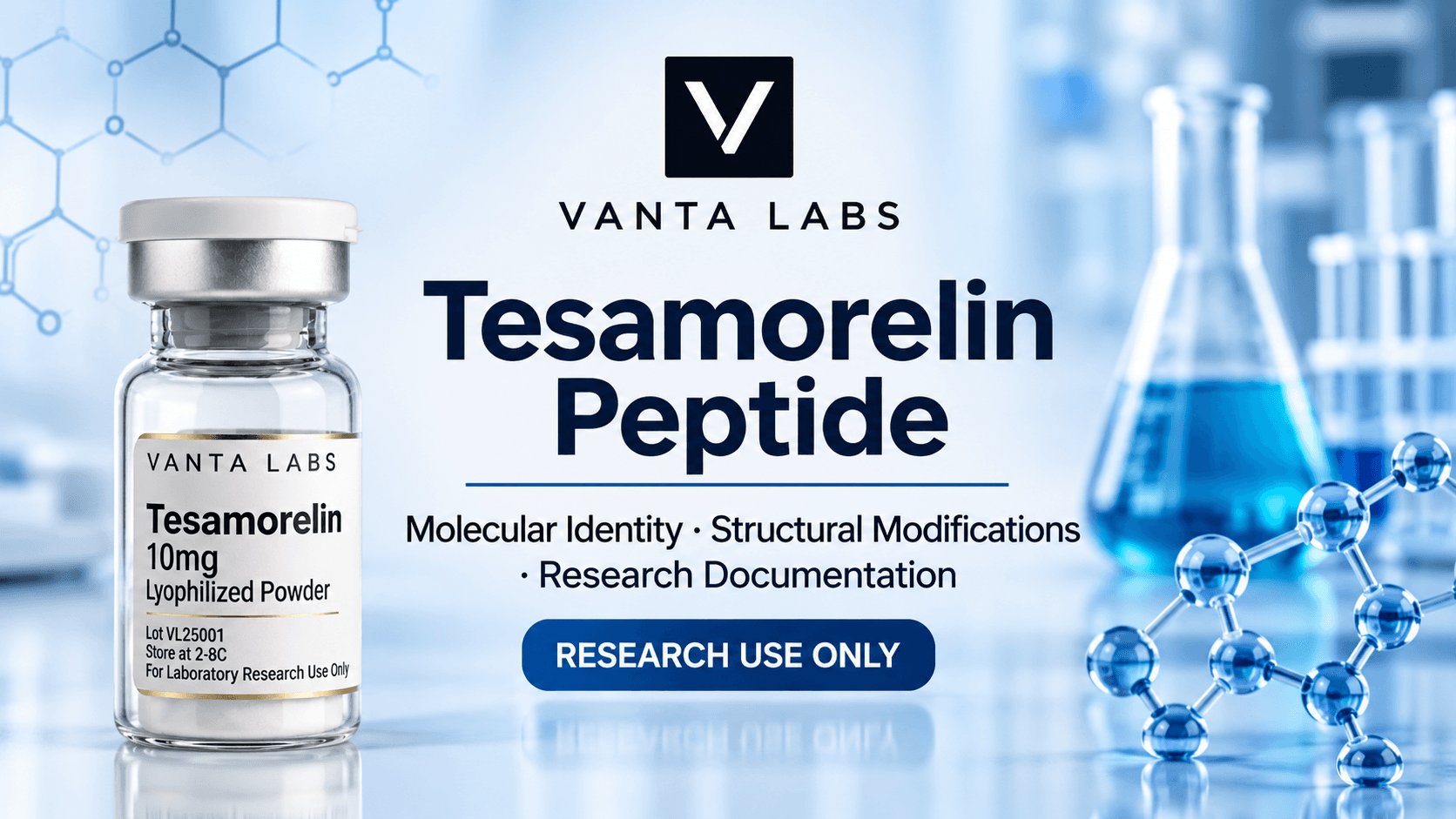
Search interest in the tesamorelin peptide keeps growing, and so does the confusion around it. Much of what appears online mixes up the molecule, the branded medicine that contains it, and the research-grade material that laboratories purchase. Those are three different things, and treating them as one leads to citation errors, mismatched documentation, and regulatory misunderstandings.
The product page already has the specification sheet — CAS number, formula, batch documentation. What it can't tell you is why two CAS numbers exist for the same peptide, or what to do when a supplier's figure doesn't match PubChem's. That's the part researchers actually get stuck on: how tesamorelin is identified, what its structural modifications mean, why two CAS numbers exist, what Research Use Only means in practice, and how to read batch-specific laboratory documentation without over-reading it.
What Is Tesamorelin? Understanding Its Scientific Identity
Tesamorelin is a 44-residue synthetic analogue of human growth hormone-releasing hormone, GHRH(1-44). Its structure is defined by two features beyond the base sequence: an N-terminal (3E)-hex-3-enoyl group (also written trans-3-hexenoyl) attached to the tyrosine residue at position 1, and a C-terminal leucinamide (Leu-NH2) group, meaning the final leucine residue ends in an amide rather than a free carboxylic acid. Together, the hexenoyl-modified N-terminus and the amidated C-terminus define the complete molecule, and both belong in any accurate structural description.
The compound also carries TH9507 (sometimes written TH-9507) as a development code and synonym. The code appears throughout the literature and in database records, so a paper that discusses TH9507 and a catalog entry for tesamorelin describe the same molecule.
One point of naming precision is worth flagging early. Because of these modifications, the compound's formal identity is usually written in sequence notation with the modifications stated explicitly, rather than as a plain one-letter amino acid string. A bare 44-letter sequence would describe the unmodified GHRH sequence, not tesamorelin. Precise notation is not pedantry here; it is what separates two different registered substances.
How Is Tesamorelin Identified in Scientific Databases?
Tesamorelin is identified by four primary reference points, and they should agree with each other wherever the compound is cited:
| Identifier | Verified value |
|---|---|
| CAS Registry Number | 218949-48-5 |
| Molecular formula | C221H366N72O67S |
| Molecular weight | 5136 g/mol (approximate) |
| PubChem CID | 16137828 |
The CAS number is the most reliable anchor. Chemical Abstracts Service assigns one registry number per distinct substance, so 218949-48-5 points to tesamorelin and nothing else. The PubChem CID serves a similar role in the National Library of Medicine's open database, where the full record includes structure, synonyms, and computed properties. These same identifiers appear in the specification section of the Vanta Labs listing, which is the right place to confirm the product-level details.
When a supplier listing, a paper, or a specification sheet gives values that conflict with these identifiers, the discrepancy deserves attention before the source is cited. Sometimes the explanation is rounding. Often, as the next section explains, the explanation is that the document actually describes a different registered form of the compound.
Tesamorelin vs Tesamorelin Acetate: Why Two CAS Numbers Exist
Tesamorelin and tesamorelin acetate are the same peptide in two registered forms, and they carry different CAS numbers. The base compound is registered as 218949-48-5. The acetate salt, in which the peptide is associated with acetate counterions, is registered separately as 901758-09-6.
The distinction is routine in peptide chemistry. Salt forms are common for synthetic peptides, and registries treat each defined form as its own substance. The amino acid sequence does not change between the two, but the overall composition and formula weight do, because the acetate contributes additional mass.
For documentation purposes, the practical rule is simple: check which identifier a record actually uses. A COA, a database entry, and a product listing may each reference a different form, and quietly mixing them produces specifications that do not reconcile. A researcher comparing a base-compound record (CAS 218949-48-5, C221H366N72O67S) against a document written for the acetate should expect, and account for, the difference rather than treating it as an error.
What Does GHRH Analogue Mean in Scientific Terminology?
GHRH analogue is a structural classification, not a performance claim. GHRH stands for growth hormone-releasing hormone, a naturally occurring 44-residue peptide described extensively in the endocrinology literature. An analogue, in chemical nomenclature, is a molecule whose structure is derived from or closely related to a reference compound.
Calling tesamorelin a synthetic GHRH analogue therefore communicates two verifiable facts: the molecule is manufactured rather than isolated from natural sources, and its sequence is based on the human GHRH sequence, carrying the N-terminal and C-terminal features described above. The classification explains where the compound sits in catalog categories such as GHRH analogues and GH secretagogues, and why it is grouped with structurally related peptides in databases.
What the term does not communicate is any outcome. Classification language describes how a molecule is built and organized, and in a Research Use Only context it should be read exactly that narrowly.
Why Is It Important to Distinguish a Molecule From a Pharmaceutical Formulation?
A molecule and a pharmaceutical formulation are different objects, and most tesamorelin confusion online traces back to collapsing the two. The molecule is a defined chemical structure with a CAS number. A pharmaceutical formulation is a finished product: a specific form of the compound, combined with specific excipients, manufactured under pharmaceutical quality systems, packaged, labeled, and approved for a defined use.
Everything that makes a medicine a medicine lives at the formulation level: the regulatory review, the manufacturing controls, the labeling, the approved specifications. None of that attaches to the bare molecule, and none of it transfers automatically to other materials that happen to contain the same structure.
This is why precise writing about tesamorelin always states which object is under discussion. A sentence about CAS 218949-48-5 concerns chemistry. A sentence about an approved product concerns one specific formulation. A sentence about a research catalog listing concerns a third thing entirely, covered in the sections that follow.
Does FDA Approval of a Tesamorelin Medicine Apply to Every Tesamorelin Product?
No. A prescription product containing tesamorelin (as the acetate) holds FDA approval, and the agency's published labeling for that product is a public record. That approval applies to one finished formulation from one sponsor, manufactured and distributed under its own regulatory controls. It does not extend to the molecule in general, and it does not extend to research-grade material sold by laboratory suppliers.
The question matters because "is tesamorelin FDA approved" is a genuinely rising search, and the accurate answer is conditional. The branded pharmaceutical formulation: approved, within its own labeling. Research-grade tesamorelin from a supplier such as Vanta Labs: not a drug product at all, and not covered by that approval in any way.
Treating a research material as if it inherited a formulation's approval status would misstate both. The honest framing, and the one Vanta Labs' own research disclaimer uses, is that the two exist in separate regulatory categories with separate rules.
What Does Research Use Only Mean for Tesamorelin?
Research Use Only (RUO) means the material is supplied solely for laboratory research. It is a classification with concrete consequences: RUO tesamorelin is not a drug, not a food, not a cosmetic, and not a dietary supplement. It is not intended for human or veterinary use, and it must not be presented as a treatment or a consumer health product.
The classification also shapes what documentation accompanies the material. An RUO supplier documents chemical identity and analytical testing, as Vanta Labs does through its product pages and COA Library. What an RUO supplier does not and cannot provide is the pharmaceutical-grade assurance attached to an approved medicine, because the material is neither produced nor reviewed under that system.
For researchers, RUO status defines the boundaries of appropriate sourcing and citation. Material classified this way belongs in laboratory settings, described in laboratory terms, with its documentation read for what it actually establishes.
What Does Lyophilized Powder Mean in a Research Product Description?
Lyophilized powder describes a physical format, nothing more. Lyophilization, commonly called freeze-drying, is a process in which a solution is frozen and the water is removed under vacuum by sublimation. What remains is a dry solid, and it is the standard presentation format for synthetic peptides in research catalogs.
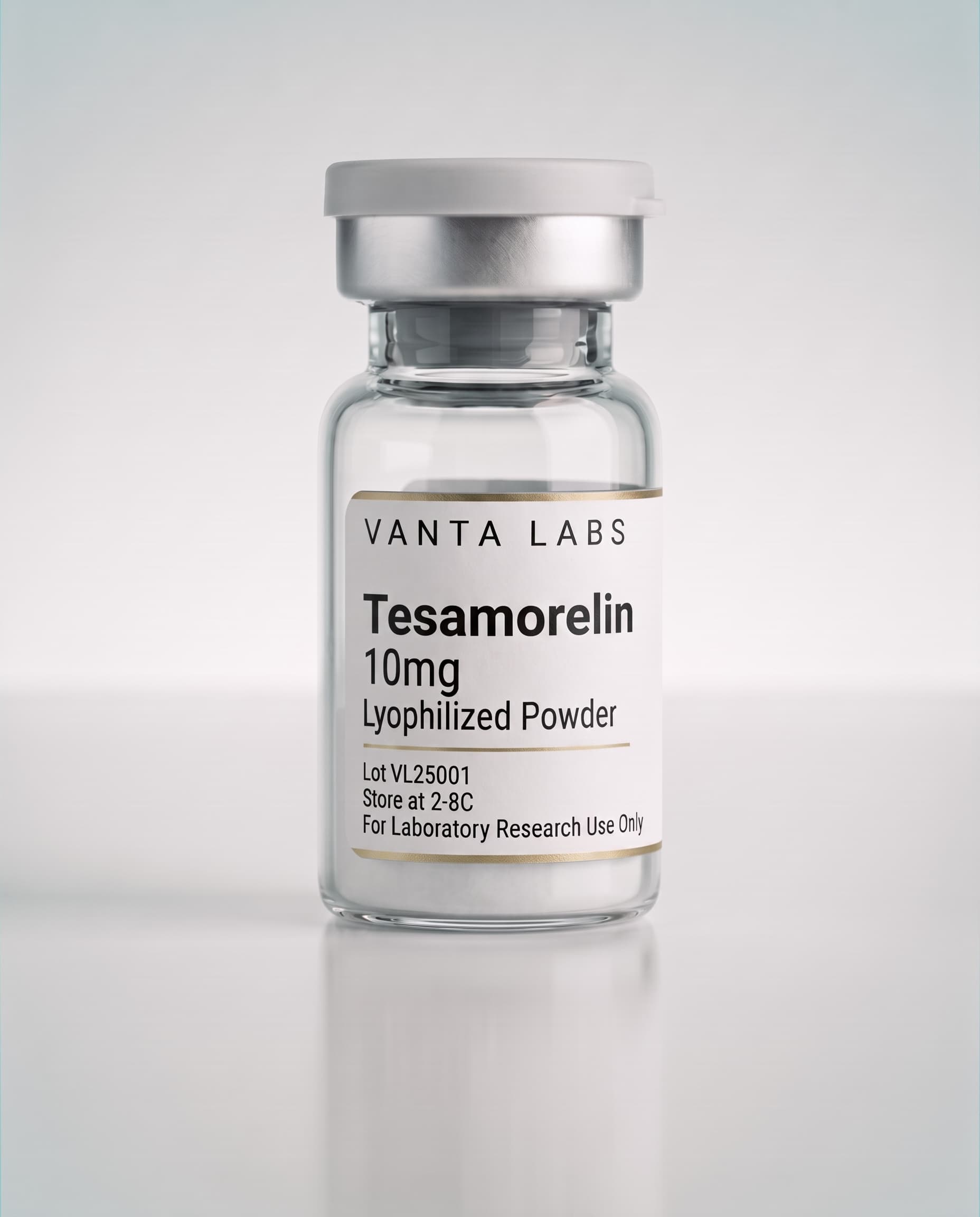
The format appears in product specifications because it is part of the material's documented description. Vanta Labs lists tesamorelin as a lyophilized powder in 5 mg and 10 mg vial sizes, and those details belong in any accurate citation of the listing, alongside the molecular identifiers.
A description of format should not be confused with guidance on use. How a laboratory handles any material is governed by its own protocols, institutional oversight, and the RUO boundaries described above, none of which a product-format term addresses.
How Should Researchers Interpret a Tesamorelin Certificate of Analysis?
A certificate of analysis is a batch document, and it should be read as one. A well-formed COA identifies the compound, the batch or lot reference, the laboratory that performed the testing, the report date, the methods used, and the results obtained. Each element matters, and each is checkable.
The Vanta Labs tesamorelin listing illustrates how batch-specific this information is. The 10 mg product's current documentation names a specific batch, lot, testing laboratory, report date, and purity figure, all published together in the COA library. Every one of those details belongs to that batch and that report. None of them is a universal claim about tesamorelin, about the 5 mg vial, about other batches, or about future inventory.
Reading a COA well also means reading it literally. The analytical method, the result, and the scope of testing should be taken from the original certificate itself rather than from summaries of it. Where a page summary and the certificate describe a detail differently, the certificate governs, and the difference is worth confirming with the supplier before the figure is cited with a method name attached. Vanta Labs' guide on how to read a COA walks through this document-first habit in more detail.
Beyond the single document, batch awareness is its own discipline, because analytical results expire in relevance the moment the batch changes. New inventory means a new batch, a new lot reference, and a new report, even when the compound and the supplier stay the same. The batch number on the COA should match the batch associated with the material in hand, the lot reference should match the vial size where the documentation distinguishes sizes, and a current listing should link to current documentation. Document traceability is the quiet test of a research supplier: a listing that ties each claim to a named batch, a named laboratory, and a dated, downloadable report gives researchers something to verify.
What Does a Reported Purity Result Actually Establish?
A purity result establishes one thing: the proportion of the detected signal attributable to the main component under the conditions of that analysis. The purity figure reported for the current batch, published in the COA library, means that, within the tested sample and the method stated on the certificate, the principal component accounted for that share of what the instrument detected.
That is a meaningful measurement, and it is also a bounded one. On its own, a purity percentage does not establish identity; confirming that the main component is in fact tesamorelin requires identity-oriented methods, which is why mass spectrometry data often accompanies chromatographic purity results in peptide testing. It does not establish sterility, endotoxin status, residual solvent levels, or water content, each of which requires its own test. And it does not describe any vial other than those represented by the tested batch.
Researchers who keep these limits in view cite analytical data accurately: as a specific result, from the method stated on a specific certificate, on a specific lot. Suppliers' own quality pages, including Vanta Labs' Testing & Quality overview, are the right place to confirm what testing a listing actually includes, rather than assuming a single percentage covers everything.
Are Tesamorelin, Sermorelin, and Ipamorelin the Same Research Compounds?
No. The three names travel together in search data, especially in comparison queries such as tesamorelin vs ipamorelin and tesamorelin vs sermorelin, but they identify three structurally distinct compounds with separate registry records.
Tesamorelin, as established above, is a modified full-length GHRH analogue: 44 residues, with an N-terminal (3E)-hex-3-enoyl modification and a C-terminal leucinamide, registered under CAS 218949-48-5 (PubChem CID 16137828). Sermorelin is a shorter GHRH-derived peptide corresponding to the first 29 residues of the human sequence, registered under CAS 86168-78-7 (PubChem CID 16132413). Ipamorelin is not a GHRH analogue at all; it is a small synthetic pentapeptide, just five residues long, registered under CAS 170851-70-4 (PubChem CID 9831659) and classified among growth hormone secretagogue peptides on structural grounds.
Sequence length alone separates them: 44 residues, 29 residues, and 5 residues are not variations of one molecule. Combination phrases that appear in search trends, such as a tesamorelin ipamorelin blend, describe products containing two distinct compounds, and accurate documentation for any such material would need to identify each component separately. For identity purposes, the comparison ends where it should begin: check each CAS number against its PubChem record, and cite each compound as itself.
What Should Be Verified Before Citing a Tesamorelin Research Specification?
Before a tesamorelin specification goes into a protocol, an order record, or a citation, five checks cover most of the risk:
- The identifiers. Confirm the CAS number, molecular formula, molecular weight, and PubChem CID against the public record, and confirm whether the source means the base compound (218949-48-5) or the acetate (901758-09-6).
- The structure. A complete structural description names both modifications: the (3E)-hex-3-enoyl group on Tyr1 and the C-terminal leucinamide. A description that mentions only one is incomplete.
- The source and its date. Prefer primary databases and the supplier's current page over secondhand summaries, and note when the page was last consulted, since listings change.
- The batch documents. Match batch and lot references between the COA and the material, and take methods and results from the original certificate itself.
- The classification and the absent claims. Record the material as Research Use Only, keep that language intact wherever the specification is reproduced, and treat unsupported figures found elsewhere online, including purity numbers with no batch reference, as unverified until shown otherwise.
None of these steps is difficult, and together they take minutes. What they buy is a citation trail in which every number can be traced to a database record or a dated laboratory document. For a compound as widely discussed and as widely misdescribed as the tesamorelin peptide, that trail is the difference between documentation and repetition.
Vanta Labs supplies laboratory research materials. Tesamorelin listed by Vanta Labs is intended strictly for laboratory research use only. It is not for human or veterinary use, and it is not a drug, food, cosmetic, or dietary supplement.
Frequently asked questions
What is Tesamorelin?
Tesamorelin is a synthetic peptide classified as an analogue of growth hormone-releasing hormone (GHRH). It is a 44-residue synthetic analogue of human GHRH(1-44), carrying an N-terminal (3E)-hex-3-enoyl modification on Tyr1 and a C-terminal leucinamide (Leu-NH2) group. It is identified by CAS number 218949-48-5 and PubChem CID 16137828, and research suppliers list it strictly as a laboratory research material.
What does the development code TH9507 refer to?
TH9507 (also written TH-9507) is a development code and synonym for tesamorelin. It appears in chemical databases and supplier listings alongside the compound name, so recognizing it helps researchers match records and literature that use the code to the same molecule.
What is the CAS number of Tesamorelin?
The CAS Registry Number for tesamorelin as a base compound is 218949-48-5. The acetate salt form, tesamorelin acetate, is registered separately under CAS 901758-09-6. When citing a CAS number, always confirm which form a document or listing actually references.
What is the molecular formula of Tesamorelin?
The molecular formula of tesamorelin is C221H366N72O67S. This formula describes the base peptide moiety rather than the acetate salt, which has a different overall composition because of the associated acetate counterion.
What is the molecular weight of Tesamorelin?
Tesamorelin has a molecular weight of approximately 5136 g/mol for the base compound. Published figures can vary slightly depending on rounding and on whether a source describes the base peptide or the acetate salt, which is one more reason to check which form a specification refers to.
How is tesamorelin different from tesamorelin acetate?
Tesamorelin acetate is a salt form of the same peptide, in which the molecule is associated with acetate counterions. The peptide sequence is identical, but the two forms carry different CAS numbers (218949-48-5 for the base compound and 901758-09-6 for the acetate) and different overall compositions. Documentation should state which form it describes.
What does GHRH analogue mean?
GHRH analogue is a structural classification. It means a molecule whose amino acid sequence is derived from, or closely related to, growth hormone-releasing hormone, a naturally occurring 44-residue human peptide. The term describes how the molecule is built and categorized in chemical databases; it is not a statement about outcomes or product performance.
What does Research Use Only mean for Tesamorelin?
Research Use Only (RUO) means a material is supplied solely for laboratory research. RUO tesamorelin is not a drug, food, cosmetic, or dietary supplement, and it is not intended for human or veterinary use. The classification reflects how the material is produced, documented, and distributed, which differs from the controls applied to approved medicines.
Does the FDA status of a branded tesamorelin medicine apply to Vanta Labs' research material?
No. FDA approval attaches to one specific finished pharmaceutical formulation produced under its own regulatory controls. It does not transfer to other materials that contain the same molecule. Vanta Labs' tesamorelin is a Research Use Only laboratory material and is not an approved drug product.
What information should a Tesamorelin COA contain?
A useful certificate of analysis identifies the compound, the batch or lot number, the testing laboratory, the report date, the analytical methods used, and the results obtained. Researchers should confirm that the batch reference on the COA matches the material in hand and read the method and result exactly as the certificate itself states them.
Related products
Sources
- Vanta Labs, Tesamorelin product page
- PubChem, Tesamorelin, CID 16137828
- PubChem, Sermorelin, CID 16132413
- PubChem, Ipamorelin, CID 9831659
- U.S. FDA, approved drug labeling for the tesamorelin-containing prescription product (regulatory reference only)
- Vanta Labs, COA Library
- Vanta Labs, Testing & Quality
- Vanta Labs, Research Disclaimer