BPC-157 + TB-500 Blend: Composition and Molecular Identity
By Vanta Labs Research teamPublished 13 min read
A documentation-focused look at the Vanta Labs BPC-157 + TB-500 research blend: its labelled composition, the molecular identity of each component, and what the batch Certificate of Analysis does and does not establish.
# BPC-157 + TB-500 Blend: Composition, Molecular Identity and Research Documentation
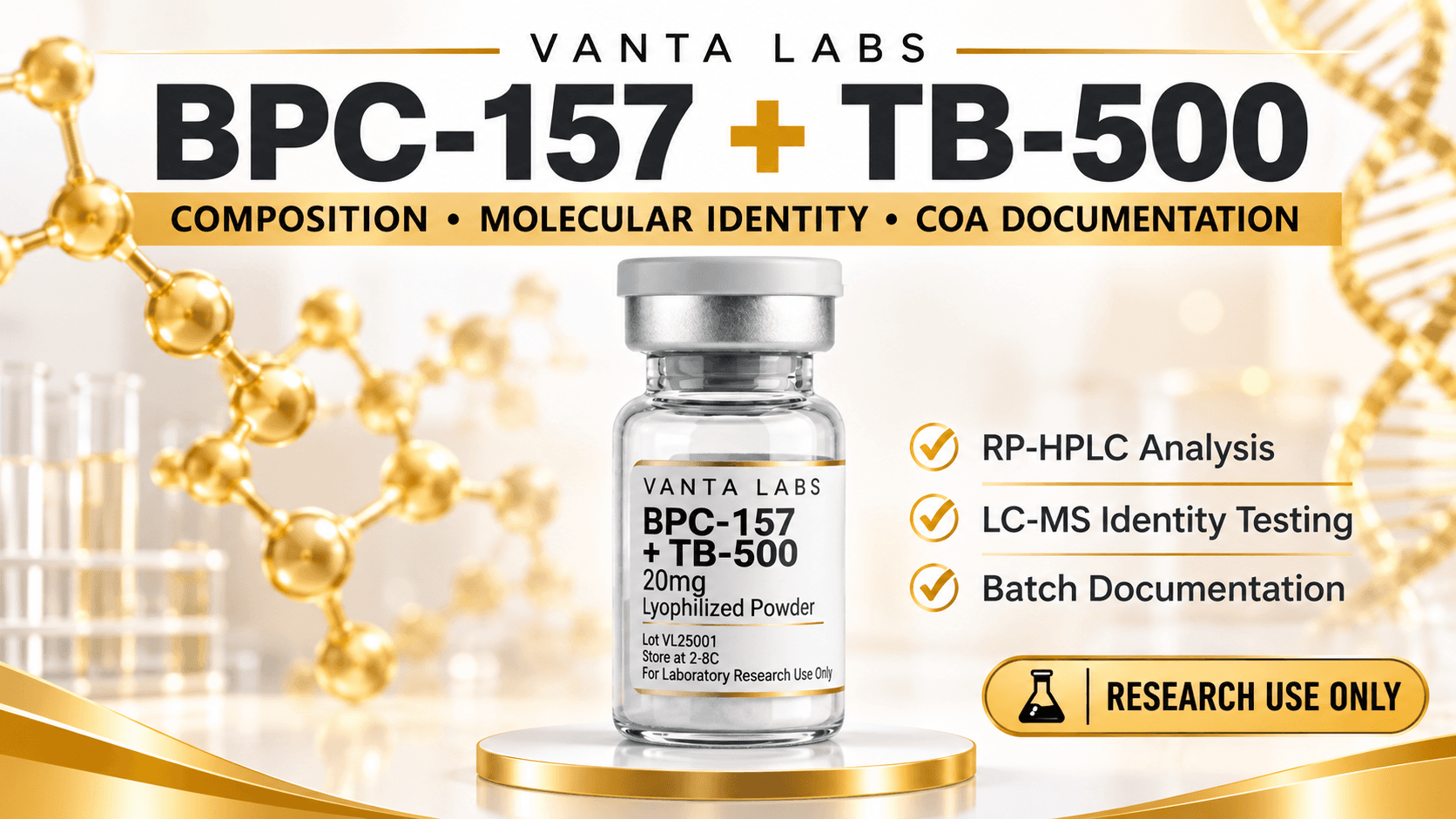
The Vanta Labs BPC-157 + TB-500 blend is a single lyophilized powder vial combining two named peptide components, BPC-157 and TB-500 (TB-4), listed as a 10 mg plus 10 mg composition for a 20 mg total. It sits in the Multi-Peptide Blends category rather than as a standalone single-compound product, and it is sold strictly for laboratory research use, not for human or veterinary use. This article covers what the listing identifies, how its two components are named and documented, and what the published batch testing does and does not establish.
What Is the BPC-157 + TB-500 Research Blend?
The product name on the current listing is "BPC-157 + TB-500 Research Blend." It is presented as a two-component research material rather than a single purified compound, which changes how it needs to be read and documented. A standalone peptide product is identified against one chemical reference and one purity figure. A blend combines two named components into one sample, so its labelled composition, its chemical identity, and its laboratory testing all need to be read at two levels: what is true of each component individually, and what is true of the combined sample as tested.
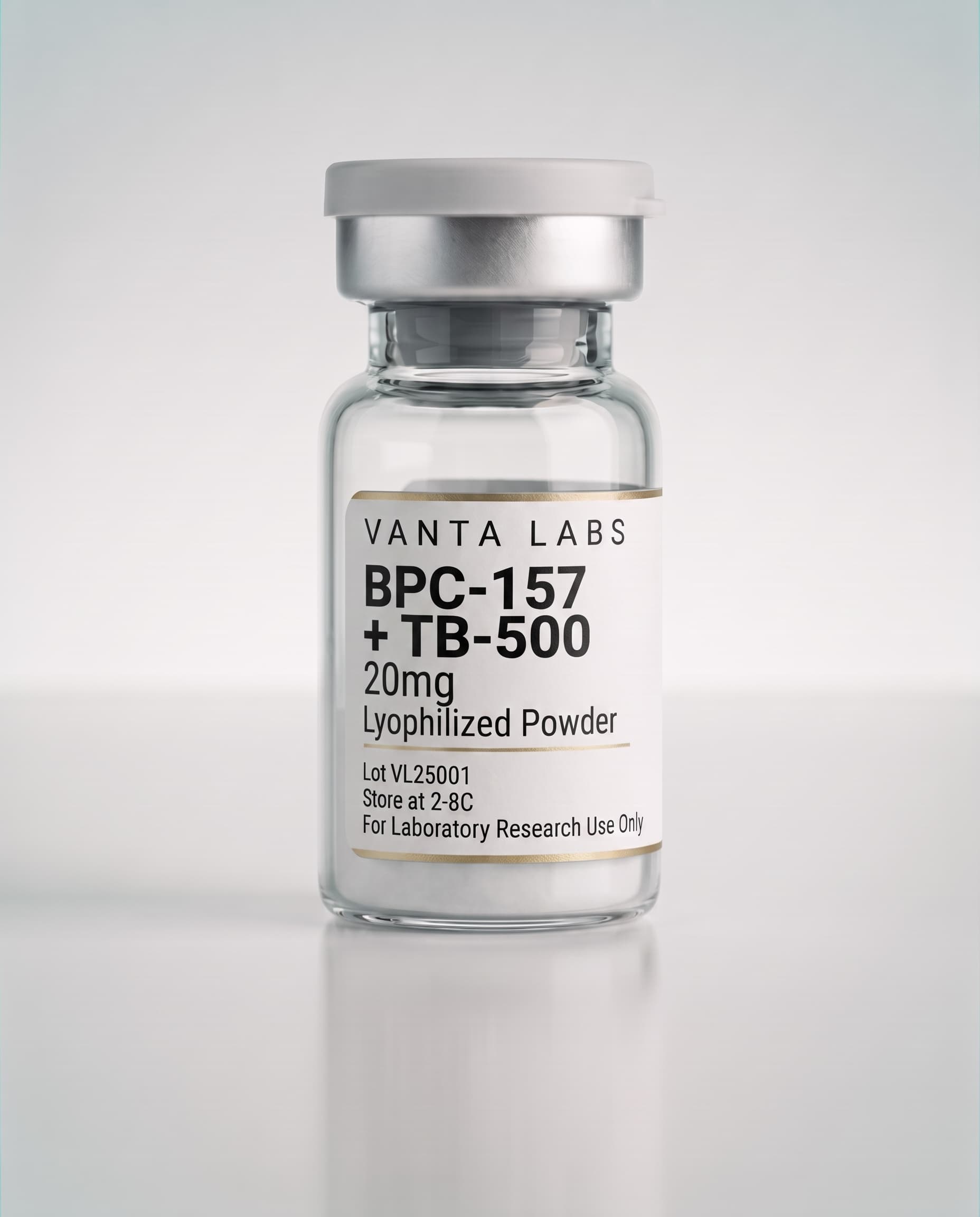
The listing supplies the blend as one lyophilized powder fill inside a single vial. This is a meaningful distinction: the product is not two separately packaged powders that a researcher combines, and it is not a kit of two vials sold together. Both labelled components occupy the same fill, which is also the sample that gets tested as a unit when the batch is certified.
BPC-157 and TB-500 Blend Composition
The current product page states the following labelled composition for the 20 mg vial size:
| Component | Labelled amount |
|---|---|
| BPC-157 | 10 mg |
| TB-500 (TB-4) | 10 mg |
| Total | 20 mg |
The 20 mg figure is the sum of the two labelled component amounts, not a separate measurement in its own right. Reading it as "20 mg of BPC-157 and TB-500 together" rather than "20 mg of each" avoids the most common misreading of this type of listing. It is also worth separating labelled amount from molecular weight: the 10 mg and 20 mg figures describe how much powder by mass is intended to be in the vial, not the molecular weight of either peptide, which is a separate chemical property discussed in the next two sections.
Understanding BPC-157 Molecular Identity
BPC-157 is documented in independent chemical references as a synthetic pentadecapeptide, meaning it is built from 15 amino acids. Its published sequence is Gly-Glu-Pro-Pro-Pro-Gly-Lys-Pro-Ala-Asp-Asp-Ala-Gly-Leu-Val. Independently verifiable identifiers for BPC-157 include a CAS Registry Number of 137525-51-0 and a PubChem Compound ID of 9941957, with a molecular formula of C62H98N16O22 and a molecular weight commonly listed between approximately 1419.5 and 1419.6 g/mol depending on the reference source (the Vanta Labs product page itself lists 1419.56 g/mol).
These identifiers describe the BPC-157 component on its own. They do not describe the combined BPC-157 + TB-500 blend, and they should not be quoted as though they were a property of the finished vial. A chemical database entry for BPC-157 is also not the same thing as a regulatory approval; a registry listing or substance record confirms that the compound has been catalogued for reference purposes, not that any health agency has approved it for a particular use.
Understanding TB-500 (TB-4) Nomenclature
This is the section of the documentation that calls for the most care, because "TB-500" is used inconsistently across the research-chemical marketplace.
The Vanta Labs listing uses the designation "TB-500 (TB-4)." In the wider literature, the name "TB-500" is frequently associated with a short, seven-amino-acid synthetic fragment bearing an N-terminal acetyl group, commonly written as Ac-LKKTETQ, which corresponds to a short internal region of the much larger, naturally occurring thymosin beta-4 protein. These are two different molecular entities with two different sets of reference identifiers: the short fragment is associated with a CAS number of 885340-08-9 and a PubChem Compound ID of 62707662, while full-length thymosin beta-4 is associated with a separate CAS number, 77591-33-4.
The important point for this product is that the batch documentation for the Vanta Labs BPC-157 + TB-500 blend does not state which of these entities, or what exact sequence, is present in the supplied material. A product name or marketing label is not, by itself, proof of a specific chemical structure. Until an analytical report independently confirms the sequence of the supplied TB-500 (TB-4) component, neither the short-fragment identity nor the full-length identity should be assumed, and neither one's molecular formula or molecular weight should be transferred onto this product's documentation as settled fact. The label terminology, "TB-500 (TB-4)," is best treated as the product's own naming convention rather than as a confirmed structural claim.
Why a Two-Component Blend Has Different Documentation Requirements
A standalone compound is documented against one identity and one purity result. A blend changes that in three ways: the sample tested in the lab is the combined powder, so a single purity result describes the mixture, not each ingredient separately; a certificate published for a different, single-component product cannot stand in for this blend's own report, since it describes a different sample under a different batch number; and identity information such as CAS numbers and molecular formulas has to be presented per component, because a blend does not reduce to one shared chemical identity. A blend therefore needs two layers of documentation read side by side: the component-level reference data above, and the blend-level batch test result below.
Understanding the BPC-157 + TB-500 Certificate of Analysis
The current product listing displays the following batch-specific record:
- Batch number: Vanta184290
- Report number: KVR-2026-47D7CA
- Testing laboratory: Kovera Labs
- Certification date: 08/24/2026
- Reported purity: 99.163% (blend average)
- Purity method: RP-HPLC, C18 column, diode-array detection at 214 nm
- Identity method: LC-MS
This report can be verified directly by its report number and access code at koveralabs.com/verify, or found through the COA Library.
This record is specific to one tested sample as of one certification date. It is not a standing guarantee that applies automatically to every future batch of the same product, and it does not describe a different vial size or a different batch than the one named on the report. Vanta Labs' own COA Library and testing-and-quality documentation instruct researchers to confirm that the batch number on their vial label matches the batch number on the report they are relying on, and to verify Kovera Labs reports directly through the laboratory's own verification portal using the report number printed on the listing, rather than relying only on the product page's summary of it.
HPLC vs LC-MS: Understanding the Analytical Difference
RP-HPLC Testing
Reversed-phase HPLC separates the components of a sample as it passes through a C18 column, with a diode-array detector recording absorbance at a set wavelength, in this case 214 nm. The compound of interest appears as the dominant peak, and any other detected substances appear as smaller peaks under the same conditions. The reported purity figure is calculated from the relative area of those peaks. This means the result reflects only what the detector can see at that wavelength: a substance that does not absorb light at 214 nm, or one that overlaps closely with the main peak, would not necessarily show up as a separate, measurable peak.
LC-MS Identification
LC-MS identity testing works differently. It compares the measured mass of the sample against the mass expected for the labelled compound. A matching mass is meaningful evidence that the sample corresponds to the intended compound, but it answers a different question than the HPLC purity test does. A sample can match on mass while still containing impurities that a purity test would flag, and a sample can show a clean purity profile while still being the wrong compound if the mass does not match. Reading the two results together, rather than treating either one as sufficient on its own, is part of reading a COA correctly.
RP-HPLC vs LC-MS Comparison
| Analytical method | Main purpose | What the result indicates | What it does not establish by itself |
|---|---|---|---|
| RP-HPLC | Chromatographic separation | Reported chromatographic purity under the stated column, detector, and wavelength | Sterility, endotoxin status, or full chemical identity |
| LC-MS | Mass-based analysis | An identity finding within the scope of the reference mass used for comparison | Sterility, endotoxin status, or suitability for any particular use |
Neither method, individually or together, is described by Vanta Labs' own testing documentation as covering sterility, endotoxin levels, residual solvents, heavy metals, or water content. The company's published testing-and-quality material states plainly that an untested parameter is not the same as a passed one.
Understanding Blend-Specific Batch Documentation
Batch numbers exist so a specific test result can be matched to a specific production run. For a two-component blend this matters more than usual, because a report for one batch cannot be assumed to apply to a different batch, a different vial size, or a single-component version of either ingredient sold separately. Vanta Labs' published guidance is to match the product name, labelled quantity, batch number, and certification date on the report against the physical vial label, then verify the report with the testing laboratory rather than relying only on how it is summarized on the product page. Each batch report describes one sample at one point in time, not a running guarantee across the catalog.
Research Use Only and Documentation Limitations
This product, and the information in this article, are provided for laboratory research purposes only. The material is not intended for human consumption, veterinary use, or any form of self-administration, and nothing in this article should be read as dosing, preparation, or administration guidance. The analytical documentation discussed above describes a tested sample under stated laboratory methods as of a specific certification date. It does not establish, and should not be read as implying, that the material is safe, sterile, or suitable for any particular use outside of a controlled research setting. Researchers evaluating this or any other research compound should rely on the original batch-matched Certificate of Analysis, verified directly with the issuing laboratory, rather than on summarized claims made anywhere else, including in this article.
Twelve Documentation Clarifications
1. What exactly does the Vanta Labs BPC-157 + TB-500 listing identify? It identifies a single product: a lyophilized powder vial containing two labelled peptide components, BPC-157 and TB-500 (TB-4), sold as a combined research material rather than as two separate single-compound products. Source: Vanta Labs product listing.
2. Does the 20 mg label refer to each component or the total? It refers to the total. The listing states 10 mg of BPC-157 and 10 mg of TB-500 (TB-4), which together equal the 20 mg figure shown as the available size. Source: Vanta Labs product listing.
3. Are the two components supplied separately or combined into one powder? They are combined into one lyophilized powder fill in a single vial. The listing does not describe or sell this product as two separate powders or as a two-vial kit. Source: Vanta Labs product listing.
4. Why does the blend have its own Certificate of Analysis? Because the tested sample is the combined powder, not each component in isolation. A blend's COA reports on the mixture as submitted for testing under one batch number, which is a different sample than a standalone single-compound product. Source: Vanta Labs testing-and-quality documentation.
5. Why is the blend COA different from a BPC-157-only COA? A standalone BPC-157 product and this blend are different products with different batch numbers and different test samples. A certificate for one cannot be substituted for the other, even if both products contain BPC-157. Source: Vanta Labs COA Library guidance.
6. What does the reported HPLC result describe? It describes the blend-average purity (99.163%) of the specific tested sample from batch Vanta184290, measured by RP-HPLC with a C18 column and diode-array detection at 214 nm, certified 08/24/2026 (report KVR-2026-47D7CA). It is a batch-specific result, not a universal specification. Source: Vanta Labs product listing; Kovera Labs methodology as described on Vanta Labs' testing documentation.
7. Does the blend-level purity result establish separate component purity? No. The reported figure is a blend average. The published documentation does not present an independently broken-out purity percentage for BPC-157 alone or for TB-500 (TB-4) alone. Source: Vanta Labs product listing.
8. What does LC-MS identification establish? It establishes that the measured mass of the tested sample matches an expected mass associated with the labelled compound, under the method used. It is an identity finding, separate from the purity question that HPLC addresses, and it does not by itself confirm sterility or suitability for use. Source: Vanta Labs research documentation on reading a COA.
9. Does the blend have one shared CAS number or molecular weight? No. CAS numbers and molecular weights are chemical properties of individual substances. BPC-157 and the TB-500 (TB-4) label each have their own separate reference identifiers; the combined product does not have one shared number for either property. Source: Vanta Labs product listing.
10. What is the difference between the TB-500 fragment reference and full-length thymosin beta-4? The commonly referenced TB-500 fragment, Ac-LKKTETQ, is a short, seven-amino-acid synthetic peptide associated with CAS 885340-08-9. Full-length thymosin beta-4 is a separate, larger protein associated with CAS 77591-33-4. They are related by name in common usage but are distinct molecular entities with distinct identifiers. Source: PubChem; Vanta Labs product listing.
11. Why does the product label not establish the exact TB-500 sequence? Because the published batch documentation for this blend does not state which specific sequence or reference entity the supplied TB-500 (TB-4) material corresponds to. A product name describes how the listing is marketed; it is not, on its own, an analytically confirmed structural identification. Source: Vanta Labs product listing.
12. Which testing categories are not covered by the published batch report? Vanta Labs' own testing documentation states that its published reports do not test for sterility, endotoxins, residual solvents, heavy metals, or water content. The absence of a reported result for any of these parameters should not be read as a passing result. Source: Vanta Labs testing-and-quality documentation.
Frequently asked questions
What is the BPC-157 + TB-500 research blend?
It is a Vanta Labs product listing that combines two named peptide components, BPC-157 and TB-500 (TB-4), into a single lyophilized powder vial for laboratory research use. The listing is classified under Multi-Peptide Blends rather than as a standalone single-compound product, and the current label states a 20 mg total content split across the two components. The product carries a Research Use Only designation and is not intended for human or veterinary use.
What does the Vanta Labs BPC-157 + TB-500 vial contain?
According to the current product listing, the vial contains two labelled components, BPC-157 and TB-500 (TB-4), combined into one lyophilized powder fill rather than packaged as two separate powders or vials. The listing states 10 mg of each component for a 20 mg total labelled amount. No other active ingredients are listed on the product page.
How much BPC-157 and TB-500 is in the 20 mg blend?
The product page lists 10 mg of BPC-157 and 10 mg of TB-500 (TB-4) per vial, which together make up the 20 mg total labelled amount shown as the available size. The 20 mg figure describes the combined content of both components, not the amount of either one individually.
What is the supplied physical form of the BPC-157 + TB-500 blend?
The product is supplied as a lyophilized (freeze-dried) powder in a single vial. The listing does not describe the product as two separately packaged powders or as a kit with multiple vials; both labelled components are contained in the same powder fill.
Does the BPC-157 + TB-500 blend have its own Certificate of Analysis?
Yes. The current listing displays a batch-specific COA for batch Vanta184290, tested by Kovera Labs. This report is specific to the blend as supplied, separate from any COA published for a standalone BPC-157 or standalone TB-500 product; the exact report number, test date, and purity figure are published in the COA itself, available through the product page or the COA Library.
How can a researcher locate the correct BPC-157 + TB-500 batch report?
The report number shown on the product's batch documentation can be checked directly at the testing laboratory's verification portal, koveralabs.com/verify. Vanta Labs also maintains a COA Library where published batch reports can be searched by batch or lot number; the published guidance is to confirm that the batch number on the report matches the number printed on the vial label before relying on it.
What does the reported HPLC result describe for this blend?
The listing reports a blend-average purity figure, published in the batch's own Certificate of Analysis, generated by reversed-phase HPLC using a C18 column with diode-array detection at 214 nm. This figure reflects the share of detected peak area attributed to the main compound signal under the stated test conditions for that specific batch sample; it is not a separately verified purity percentage for BPC-157 alone or TB-500 alone.
What does LC-MS identification indicate in the blend report?
LC-MS identity testing compares the measured mass of the sample against an expected mass to help confirm that the tested material corresponds to the labelled compound. It answers a different question than the HPLC purity result does. An LC-MS identity result does not, by itself, establish sterility, endotoxin status, or suitability for any particular use.
Why should the blend COA be checked separately from a BPC-157-only COA?
A multi-component blend is tested and certified as its own sample. A certificate published for a standalone BPC-157 product describes a different sample under a different batch and cannot be substituted for the blend's own report. Vanta Labs' published testing guidance states that each vial size and each product is tested and reported on its own.
Does the BPC-157 + TB-500 blend have one CAS number?
No. CAS numbers are assigned to individual chemical substances, not to a combined two-component product. BPC-157 and the TB-500 (TB-4) label each carry their own reference identifiers, and the product listing itself states that the blend does not have one shared CAS number or molecular weight.
What does the TB-500 (TB-4) label mean on the product documentation?
TB-500 (TB-4) is the designation Vanta Labs uses on this listing. In the wider research-chemical literature, TB-500 is commonly associated with a short synthetic fragment (Ac-LKKTETQ) derived from a region of the full-length thymosin beta-4 protein, but these are two distinct molecular entities with different reference identifiers. The batch documentation for this product does not specify which sequence the supplied material corresponds to, so neither identity should be assumed without independent confirmation.
How is a two-component blend documented differently from a single-compound product?
A single-compound product is typically identified and tested against one CAS number, one molecular formula, and one set of reference data. A two-component blend like this one requires documentation that addresses each labelled component's identity separately, alongside a blend-level test result, such as the combined HPLC purity figure, that describes the mixed sample as a whole. Readers should not collapse these two layers of information into a single figure for either ingredient.
Related products
Sources
- Vanta Labs, BPC-157 + TB-500 product listing
- Vanta Labs, Certificates of Analysis Library
- Vanta Labs, How to Read a Certificate of Analysis
- Vanta Labs, Testing and Quality
- Vanta Labs, Purity and Third-Party Testing
- Kovera Labs, batch verification portal
- PubChem, Compound Summary for CID 9941957 (BPC-157)
- PubChem, Compound Summary for CID 62707662 (TB-500 fragment, Ac-LKKTETQ)